What is geographic tongue?
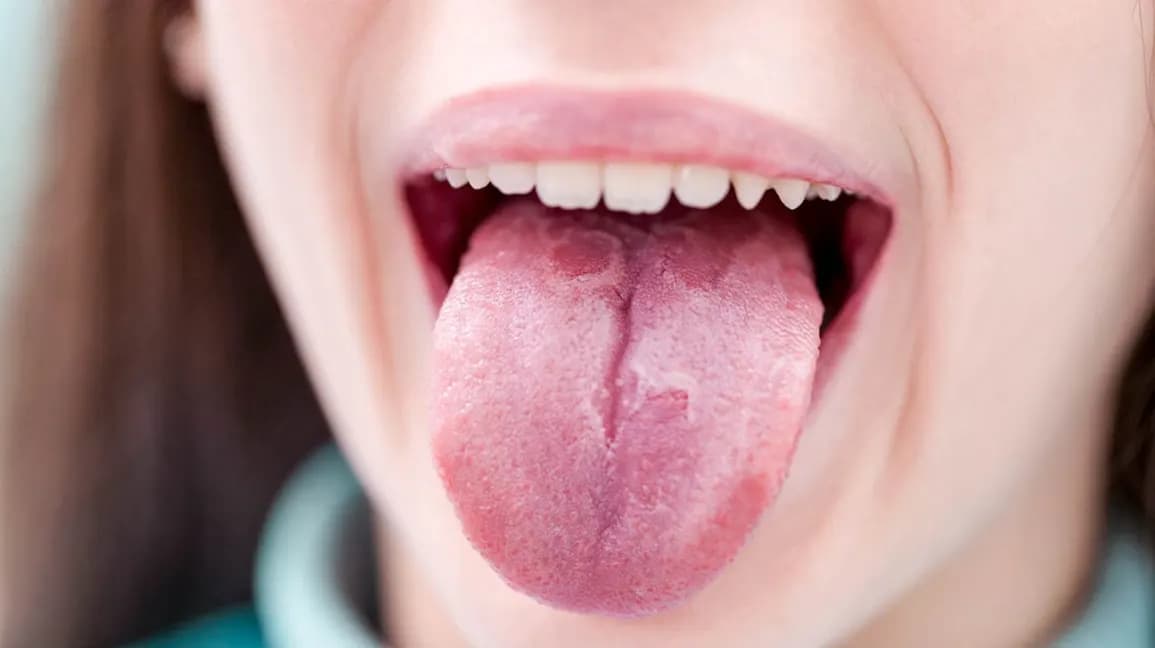
Geographic tongue is a harmless, non-contagious inflammatory condition of the tongue's surface. Smooth red patches appear on the top and sides of the tongue, each framed by a thin white or grey border, and the pattern looks like the land masses and seas on a map, hence the name (DermNet, Cleveland Clinic, AAOM). Doctors also call it benign migratory glossitis, because the patches move around, and the same change elsewhere in the mouth is called geographic stomatitis or erythema migrans (AAOM). People often search for it under the names "map tongue", "mapped tongue" or "patches on the tongue".
The red areas are places where the tiny hair-like filiform papillae that normally coat the tongue have temporarily been shed, leaving a thinner, smoother surface; the white rim is where the surface layer has stayed on longer (DermNet, Oral Health Foundation). Because the red patches are thinner than normal, they can be more sensitive and slightly more prone to a thrush infection, but they are not an infection themselves (Oral Health Foundation, DermNet).
- It affects roughly 1 to 3% of adults worldwide, and possibly more, because many people never notice it or never seek advice (DermNet, Cleveland Clinic, AAOM).
- Women are affected one and a half to two times as often as men (DermNet, PMC paediatric review).
- It is reported in all ages from babies to older adults, is slightly more common in young adults, and is seen less often in children than in adults (Cleveland Clinic, DermNet, PMC paediatric review).
- It often runs in families, together with its close relative, fissured tongue (DermNet, Cleveland Clinic).
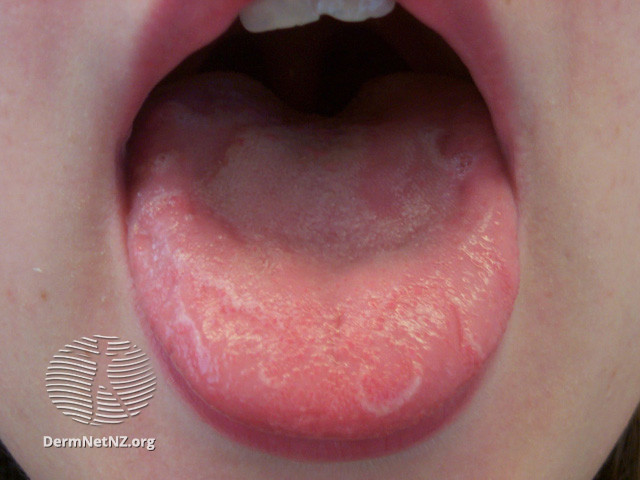
Symptoms
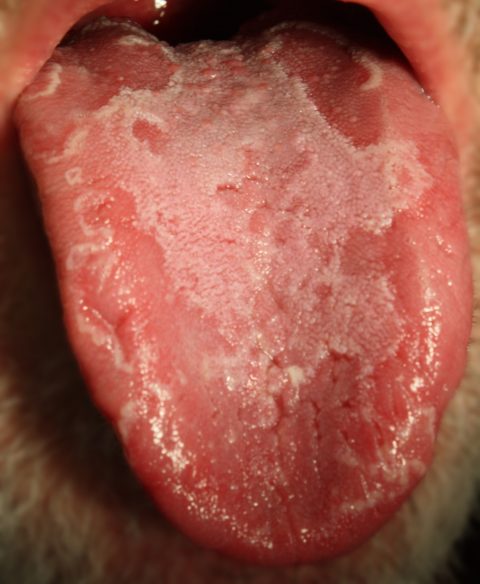
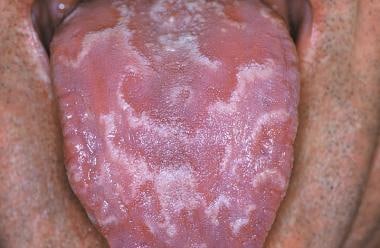
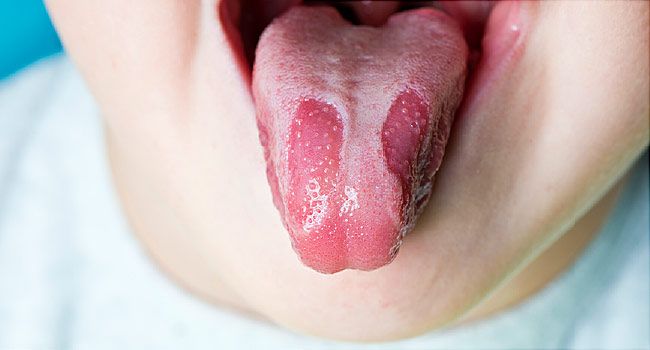
- Irregular, smooth red patches on the top, tip or sides of the tongue, sometimes slightly swollen, each with a thin white or greyish edge (DermNet, Cleveland Clinic).
- The patches migrate. Over days to a few weeks a patch heals and a new one appears elsewhere. An episode can appear suddenly, last for weeks, months or longer, disappear completely, and then return (DermNet, AAOM, PMC paediatric review).
- Most people feel nothing (DermNet, AAOM). When there are symptoms, they are a burning, stinging or tingling sensation, soreness or a changed sense of taste, typically set off by hot, spicy, salty or sour food and drink such as citrus fruit, fruit juice and acidic drinks (DermNet, Cleveland Clinic, PMC paediatric review). People who seek care are a different group: in a 2025 hospital series of 163 patients, 65% reported symptoms (PMC severity study).
- Fissured tongue often comes with it. Grooves and cracks on the tongue surface were present in 84% of patients in the same series, and symptoms were linked to the fissures rather than to how extensive the map pattern was; debris caught in the grooves is one reason a geographic tongue becomes sore (PMC severity study, DermNet fissured tongue).
- Occasionally the glands under the jaw feel slightly swollen, or similar patches appear on the inside of the cheeks, the palate, the gums or under the tongue (Cleveland Clinic, AAOM).
What causes geographic tongue?
The cause is not known. It is not an infection, it is not caused by food, and it is not a sign of cancer (DermNet, Cleveland Clinic, AAOM). It is an inflammatory condition that comes and goes in people prone to it. Several associations are reported, although none has been proven to cause it (AAOM, PMC paediatric review):
- Family history. Geographic tongue and fissured tongue cluster in families, and the children of an affected parent are more often affected than other children (DermNet, PMC paediatric review). A third of patients in the 2025 series knew of an affected relative (PMC severity study).
- Psoriasis. Geographic tongue is more common in people with psoriasis, particularly the pustular form, and some specialists regard it as an oral form of psoriasis because the two look alike both clinically and under the microscope and share an immune-gene marker (HLA-Cw6); others think the two simply coincide. Most people with geographic tongue do not have psoriasis: in a 2025 series of 163 patients none had been diagnosed with it (DermNet, AAOM, PMC paediatric review, DermNet oral psoriasis, PMC severity study).
- Allergic and atopic conditions: hay fever and other airborne allergies, asthma, atopic eczema, food allergy and allergic contact dermatitis are reported more often in people with geographic tongue (DermNet, Cleveland Clinic, PMC paediatric review).
- Hormones. Hormonal fluctuation is a commonly reported trigger: the condition is more often seen in women taking the contraceptive pill, in whom flare-ups track the pill cycle (Cleveland Clinic, PMC paediatric review).
- Emotional stress is a commonly reported trigger, although it has not been proven to cause the condition (DermNet, AAOM, Cleveland Clinic).
- Nutritional deficiencies. Low iron, zinc, folate, vitamin B6 or vitamin B12 have been associated with geographic tongue in some people (Cleveland Clinic); iron, B12 or folate deficiency can also itself cause a sore, red tongue (NHS B12 anaemia, NHS iron deficiency).
- Other associations include type 1 diabetes, especially early in the disease, reactive arthritis and anaemia (DermNet, Cleveland Clinic, PMC paediatric review).
- Smoking, perhaps surprisingly, is not a risk factor: smokers had a lower prevalence in the studies reviewed, and smoking made no difference to severity in the 2025 series; tobacco can still irritate a sore patch (PMC paediatric review, PMC severity study).
Irritants do not cause the condition, but they make an existing patch hurt: very hot, spicy or acidic foods, alcohol and tobacco, strongly flavoured or whitening toothpastes and toothpastes containing the foaming agent sodium lauryl sulphate (NHS tongue, PMC paediatric review, DermNet); hard brushing, sharp tooth edges, rough fillings, braces and dentures rub the tongue as they do any other part of the mouth (NHS ulcers, HSE ulcers, MedlinePlus glossitis).
Is geographic tongue dangerous, contagious or a sign of cancer?
- Not dangerous. There are no major long-term complications (DermNet), and it does not cause health problems (Cleveland Clinic).
- Not contagious. It is not an infection, so it cannot be passed on by kissing, sharing cutlery or anything else (AAOM, Oral Health Foundation).
- Not cancer and not pre-cancerous. No case of geographic tongue turning into mouth cancer has been reported, and a biopsy is almost never needed because the appearance is so typical (AAOM). The caveat: a red or white patch that stays in one place and does not change over two to three weeks, or any mouth ulcer lasting more than three weeks, is a different problem and must be checked (NHS mouth cancer, DermNet leukoplakia, Cleveland Clinic).
- "Ringworm on the tongue" does not exist. The ring-shaped patches of geographic tongue are sometimes mistaken for ringworm, but ringworm is a fungal infection of the skin, including the scalp; it is not a tongue condition (NHS ringworm). The fungal condition of the mouth is thrush, which looks different (NHS thrush).
How long does geographic tongue last?
Each patch lasts days to a few weeks before it heals and a new one forms elsewhere. An episode of active patches can last weeks, months or longer, then clear completely for a time before the next one. In most people the condition eventually settles on its own, but it is best thought of as a relapsing condition rather than one that is cured: flare-ups come and go, and are reported more often at times of stress or hormonal change (DermNet, Cleveland Clinic, AAOM, PMC paediatric review).
Geographic tongue or something else? A look-alike guide
A red, white or sore tongue has many causes, and some of them need treatment or an urgent check (NHS tongue). Geographic tongue is recognised by smooth red patches with a white rim that change shape and position over days, with an otherwise normal mouth. Use the table to prepare questions, not to diagnose yourself.
| Condition | How it differs from geographic tongue |
|---|---|
| Oral thrush (candida infection) | Creamy white patches or a cottage-cheese-like coating on the tongue and inner cheeks that, unlike milk, do not rinse away; when scraped they come off with difficulty, leaving sore red areas that can bleed. Common in babies, denture wearers, after antibiotics, with steroid inhalers, diabetes or a weakened immune system. Thrush can also settle on top of a geographic tongue (NHS thrush, Cleveland Clinic thrush, DermNet candidiasis). |
| Fissured tongue | On its own: grooves and cracks on the top of the tongue without red patches. Harmless, may be inherited, and frequently present together with geographic tongue; sore only when food debris collects in the grooves (DermNet fissured tongue). |
| Smooth, sore tongue from anaemia (atrophic glossitis) | The whole tongue becomes red, swollen, smooth and sore rather than patchy, usually with tiredness and sometimes with mouth ulcers or cracks at the corners of the mouth (angular cheilitis). Caused by iron, vitamin B12 or folate deficiency and confirmed by a blood test (NHS B12 anaemia, NHS iron deficiency, MedlinePlus glossitis). |
| Oral lichen planus | Fine white lace-like lines or patches on the inner cheeks, tongue or gums that do not migrate, sometimes with painful sore areas and burning when eating; lasts years and needs assessment and long-term follow-up because, rarely, the erosive form can turn cancerous (DermNet oral lichen planus, NHS lichen planus). |
| Oral leukoplakia | A fixed white patch that cannot be wiped off and does not go away, six times more common in smokers. It must be examined and biopsied, because some patches contain pre-cancerous change (DermNet leukoplakia, NHS mouth cancer). |
| Mouth cancer | An ulcer lasting more than three weeks, a lump, a red or white patch that persists, pain that does not settle, difficulty swallowing or a hoarse voice. See a GP or dentist promptly; early cancer can look like an ordinary ulcer (NHS mouth cancer). |
| Mouth ulcers (aphthous ulcers) | Round or oval painful sores with a yellow-grey base and a red halo, usually on the inside of the lips and cheeks or under the tongue; they heal within one to two weeks. Several at once can point to hand, foot and mouth disease, Crohn's or coeliac disease (NHS ulcers, HSE ulcers, DermNet aphthous). |
| Herpes simplex (cold-sore virus) | A first infection causes clusters of small painful blisters and ulcers throughout the mouth, with fever and swollen glands, mostly in children; later cold sores usually sit on the lips, occasionally as a small cluster of pinhead ulcers inside the mouth (DermNet herpes simplex, NHS ulcers). |
| Oral psoriasis | Uncommon, and more likely in people with severe or pustular psoriasis: irregular red patches with raised yellow-white borders that look very like geographic tongue (DermNet oral psoriasis), which is why some specialists consider the two one condition (AAOM). |
| Hairy tongue | A brown, black, yellow or green furry coating on the back of the tongue from overgrown papillae, usually in adults over 40, smokers or people taking certain medicines; harmless and cleared by gentle scraping (DermNet hairy tongue). |
| Burning mouth syndrome | A persistent burning or scalded feeling, most often on the tongue, with a mouth that looks completely normal; mainly in women around and after the menopause. It is a diagnosis of exclusion once thrush, deficiencies and other causes have been ruled out (DermNet burning mouth, Cleveland Clinic burning mouth). |
| Median rhomboid glossitis | A single diamond-shaped smooth red area in the middle of the back of the tongue that does not move; it is a form of candida infection (DermNet candidiasis). |
When to see a doctor or dentist
Typical geographic tongue, with migrating patches and little or no discomfort, needs no appointment. See your dentist or GP within a few days in these situations (NHS tongue, NHS thrush, HSE thrush, Oral Health Foundation, MedlinePlus glossitis):
- burning, pain or sensitivity is interfering with eating, drinking or speaking despite a pharmacy numbing gel, or has not improved after two weeks of avoiding irritants;
- you see white patches or a coating that leave sore red areas when scraped (likely thrush), or you have thrush and a weakened immune system or take medicines that suppress it; a baby under four months with any white coating in the mouth that is not milk must be seen by a GP, and so must a baby of any age who is reluctant to feed or dribbling more than usual;
- the tongue is sore, smooth and red all over, or you also feel tired, breathless or dizzy (possible anaemia or vitamin deficiency);
- you want the diagnosis confirmed, which is sensible for any tongue change you have not had before.
Do not wait: ask for an appointment now if you have a mouth ulcer that has lasted more than three weeks, a red or white patch that stays in one place and does not go away, a lump in the mouth, lip or neck, unexplained bleeding, pain that is getting worse, difficulty swallowing or a hoarse voice that is not going away. These are the symptoms that must be checked for mouth cancer, and they are not features of geographic tongue (NHS mouth cancer, NHS ulcers). Tongue swelling that affects breathing or swallowing is an emergency (MedlinePlus glossitis).
How geographic tongue is diagnosed
A dentist, GP or dermatologist diagnoses geographic tongue by looking at it and asking a few questions: how long the patches have been there, whether they move, what makes the tongue sore, and whether anyone in the family has the same thing (DermNet, Cleveland Clinic). Tests are rarely needed and, when done, are usually normal (DermNet). A blood count and iron, B12 and folate levels are checked when the whole tongue is sore and smooth, or when there are other signs of anaemia (MedlinePlus glossitis, NHS B12 anaemia). A swab is taken if thrush is suspected (DermNet candidiasis), and a biopsy is reserved for the rare patch that stays fixed in one place, looks atypical or fails to behave like geographic tongue (AAOM, DermNet leukoplakia).
Treatment
No treatment removes geographic tongue and most people need none; an explanation and reassurance are usually enough (DermNet, AAOM, Cleveland Clinic). When a flare-up is sore, the aim is to take away what irritates the thin patches and to calm them while they heal:
- Avoid your triggers for two weeks: very hot, spicy, salty and sour or acidic food and drink (citrus fruit, fruit juice, acidic drinks), alcohol and tobacco (DermNet, Cleveland Clinic, NHS tongue, PMC paediatric review).
- Change the toothpaste. Use one without sodium lauryl sulphate and without strong whitening or tartar-control additives, and brush the tongue gently with a soft brush rather than scrubbing it (NHS tongue, PMC paediatric review, DermNet fissured tongue).
- Rinse. A warm salt-water rinse (half a teaspoon of salt in a glass of warm water, spat out) or a mild alcohol-free mouthwash soothes and keeps the surface clean (NHS ulcers, NHS lichen planus).
- Pharmacy options for pain. A pharmacist can suggest a numbing (local anaesthetic) gel, spray or mouthwash for use in the mouth, used for a short time as directed (NHS tongue, DermNet, AAOM).
- Prescription treatment for stubborn soreness. A doctor may prescribe an antihistamine-and-anaesthetic mouth rinse, a short course of an anti-inflammatory steroid rinse or gel, or a non-steroid immune-calming ointment applied to the patches, for a limited time and under instruction (DermNet, AAOM, Cleveland Clinic, PMC severity study).
- Treat what is on top of it. If thrush has developed on the thin patches, an antifungal gel or liquid from the pharmacy or GP usually clears it within one to four weeks (Oral Health Foundation, NHS thrush, DermNet candidiasis); if a blood test shows low iron, B12 or folate, treating the deficiency is the treatment for that sore tongue (MedlinePlus glossitis, NHS iron deficiency).
No diet, supplement or mouthwash is proven to prevent recurrences (PMC paediatric review); be wary of anything sold online as a "cure".
Day-to-day care and preventing flare-ups
- Keep a two-week food and symptom diary to find your own triggers; they differ from person to person, and between episodes most people eat normally.
- Gentle oral hygiene: a soft toothbrush, a mild toothpaste, flossing and brushing the top of the tongue lightly so that food does not collect in any fissures (DermNet fissured tongue, MedlinePlus glossitis).
- Do not scrub or scrape the red patches. They are thinner and more sensitive than the rest of the tongue (Oral Health Foundation).
- Keep the mouth moist: drink enough water; a dry mouth favours thrush, which likes to settle on the thin patches (DermNet candidiasis).
- Regular dental checks. Sharp tooth edges, rough fillings and badly fitting dentures or braces rub the tongue; a dentist can smooth or adjust them (NHS ulcers, MedlinePlus glossitis).
- Stress is a commonly reported trigger; manage it and your sleep where you can (DermNet, Cleveland Clinic).
Geographic tongue in children and in pregnancy
Children can have geographic tongue, including toddlers, and in most children it causes no symptoms and is found by chance by a parent or dentist; reported prevalence in children ranges widely between studies, and symptomatic cases are rare. Reassurance, avoiding acidic or spicy foods during a flare and a soft toothbrush are all that is normally needed; the condition is not an illness in itself and needs no treatment (PMC paediatric review, Cleveland Clinic). Any white coating in a baby's mouth that is not milk needs checking, a baby under four months with it must be seen by a GP, and a feverish child with mouth ulcers is a different problem that should be seen (NHS thrush, HSE thrush, HSE ulcers).
Pregnancy brings large hormonal shifts, and hormonal fluctuation is a commonly reported trigger for geographic tongue, with flare-ups known to track the contraceptive pill cycle (Cleveland Clinic, PMC paediatric review); whether pregnancy itself provokes it has not been studied well. Geographic tongue is a benign surface condition of the tongue and is not an infection, so there is nothing to pass on (AAOM, Oral Health Foundation). If your tongue changes during pregnancy, the same look-alike rules apply; use only the simplest measures (trigger avoidance, salt-water rinses, a mild toothpaste), and ask a pharmacist, dentist or doctor before using any medicated gel or rinse.
Online dermatologist consultation
If the patches on your tongue are new and you would like a specialist opinion without waiting, you can book an online consultation with an iDerma dermatologist. From clear, well-lit photographs of the tongue, including the sides and the underside, the dermatologist can tell you whether the appearance fits geographic tongue, which look-alikes they would still want to exclude, what to avoid and what to try first for the burning, and whether a dentist, GP or oral-medicine clinic should examine you in person. A photo consultation cannot replace an in-person examination for a fixed patch, a lump, an ulcer that has lasted more than three weeks, unexplained bleeding, worsening pain, difficulty swallowing or a persistent hoarse voice: those need to be seen and, if necessary, biopsied.
What to do now
- Photograph the tongue today and again in one to two weeks. If the red patches have changed shape or position, the picture fits geographic tongue (DermNet).
- Cut out the obvious irritants for two weeks: spicy, acidic and very hot food, alcohol, strong or whitening toothpastes (NHS tongue, PMC paediatric review).
- Swap to a sodium-lauryl-sulphate-free toothpaste and a soft brush, and rinse with warm salt water after meals (NHS tongue, NHS ulcers).
- Ask a pharmacist about a short-term numbing gel if the burning interferes with eating; see a dentist or GP if it still does (NHS tongue).
- Book a dentist or GP appointment if a patch stays fixed in one place and does not change over two to three weeks, any ulcer lasts more than three weeks, or you have signs of thrush or anaemia (NHS mouth cancer, NHS thrush, NHS B12 anaemia).