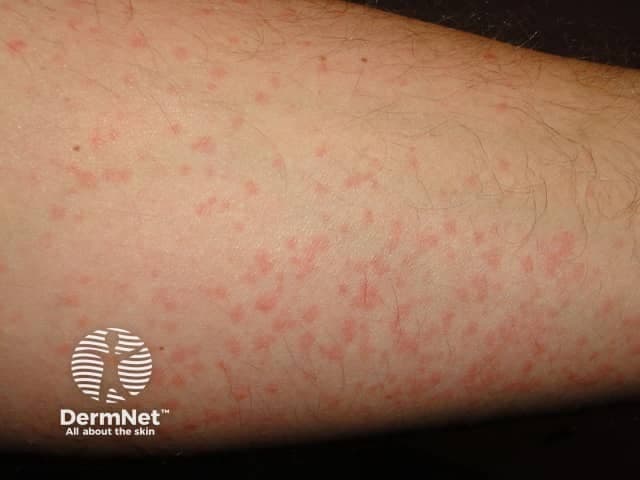
What is cold urticaria?
Cold urticaria, sometimes called cold hives, is a form of hives (urticaria) brought on by cold. Within minutes of cold air, cold water or a cold object touching the skin, itchy raised weals (hives) appear on the chilled area, sometimes with deeper swelling (DermNet, BAD). It belongs to the chronic inducible urticarias: hives with a specific physical trigger, as opposed to hives that appear spontaneously (DermNet, BAD). It is not an allergy to a substance such as pollen or a food. The trigger is the temperature change itself (BAD).
It is uncommon, affecting about 0.05% of people (DermNet). Most reactions stay on the cooled skin and settle within 1 to 2 hours (DermNet). Cooling a large area of skin at once, most often while swimming, can set off a whole-body reaction (DermNet, BAD), which is why it needs to be taken more seriously than an ordinary itchy rash.
At iDerma the usual story is weals on the hands and face after a winter walk, or on the legs after cold water, repeating every time the weather turns. The repetition is the clue.
Acquired cold urticaria is a different disorder from familial cold autoinflammatory syndrome, a rare inherited condition once called hereditary cold urticaria (DermNet). This article covers the acquired form.
Who gets cold urticaria?
It mostly affects young and middle-aged adults, although it can start in childhood or later life, and it is about twice as common in women as in men (DermNet). It commonly occurs together with dermographism (weals where the skin is stroked or scratched) and cholinergic urticaria (tiny weals with sweating), and sometimes with ordinary (spontaneous) urticaria (DermNet).
What causes cold urticaria?
Cold makes mast cells in the skin release histamine and other inflammatory chemicals. These make small blood vessels leak fluid into the skin, and that fluid is the weal (DermNet, BAD). Why cold has this effect in some people and not others is not known (DermNet).
Most cases are primary: no underlying cause is found (DermNet). A minority are secondary to another condition. The reported associations are cryoglobulinaemia (abnormal blood proteins that clump in the cold), chronic lymphocytic leukaemia, lymphosarcoma, chickenpox, syphilis, viral hepatitis, glandular fever and other respiratory viral infections, and immunisations (DermNet). This is why a doctor may order blood tests once the diagnosis is made.
Common triggers
- Cold air, wind and rain on exposed skin (BAD, DermNet).
- Cold water: swimming, cold showers, washing hands in cold water (DermNet, BAD).
- Cold objects, ice packs and cold-based skin treatments such as cryotherapy (DermNet).
- A rapid drop in skin temperature followed by rewarming (ACAAI).
Symptoms: what cold urticaria looks like
Symptoms start within 2 to 5 minutes of the cold exposure and last 1 to 2 hours (DermNet).
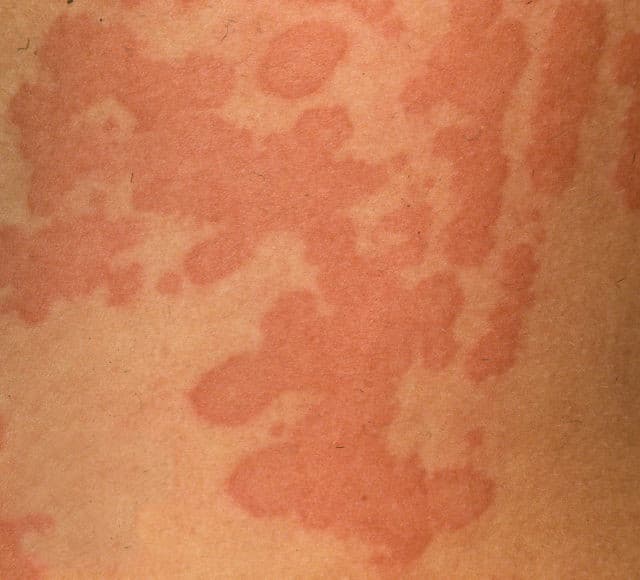
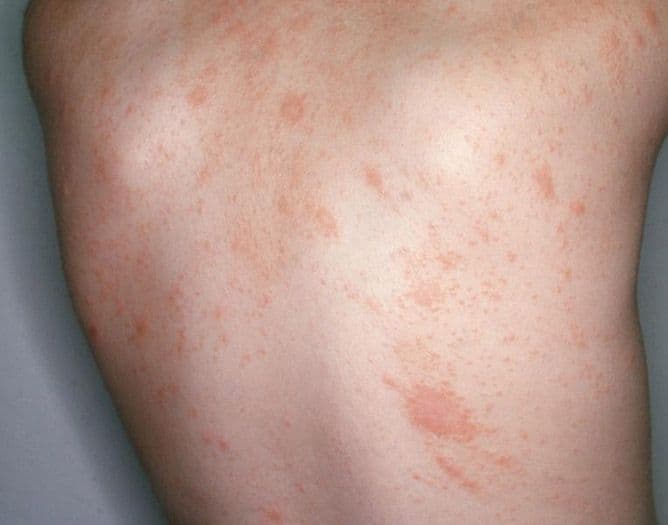
- Itchy weals (hives) on the cooled skin: raised bumps or patches that may be round, ring-shaped or joined into larger plaques, and that come and go within hours (BAD, DermNet). On white skin they look pink or red; on brown and black skin the colour is harder to see and the weals may look skin-coloured and puffy (NHS, HSE).
- Stinging or burning as well as itch (NHS, HSE).
- Angioedema, a deeper swelling that in urticaria usually affects soft areas such as the eyelids and lips and tends to be painful rather than itchy (BAD). In cold urticaria it can be localised or widespread (DermNet).
- Whole-body symptoms in some people: shortness of breath or wheeze, abdominal pain, a racing or irregular heartbeat and, in very severe cases, a drop in blood pressure, collapse and anaphylaxis (DermNet).
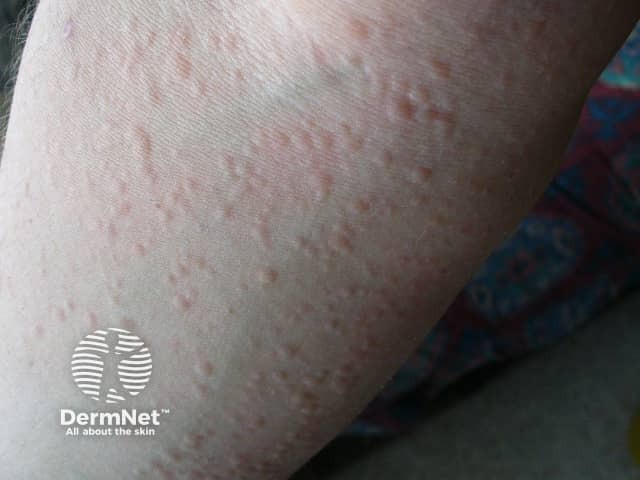
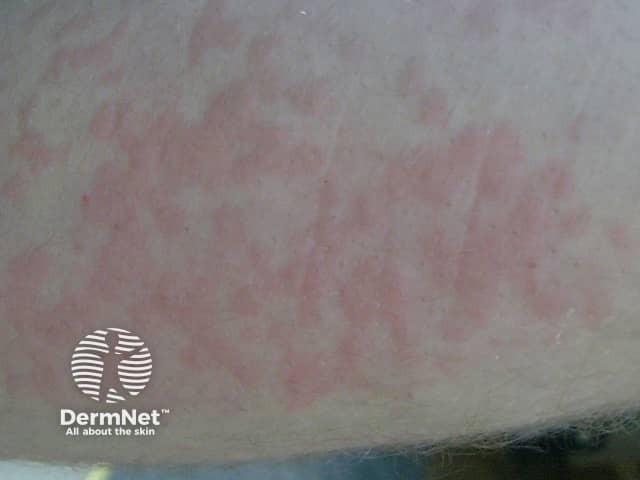
Cold urticaria: scattered itchy weals on a forearm, and blotchy, confluent weals on a larger area of chilled skin.
Everyday exposures are enough to start a reaction: a cold wind on the face, handling frozen food, rinsing hands under a cold tap. Swimming in cold water is the most common cause of a severe reaction, because a large area of skin is cooled at the same time (DermNet).
Is cold urticaria dangerous?
For most people it is an itchy, uncomfortable rash that settles within two hours of warming up (DermNet). The danger comes from cooling a large area of skin at once. Swimming or plunging into cold water can cause extensive wealing with fainting (BAD), a sharp fall in blood pressure, shock and, in very severe cases, death (DermNet). Severe reactions have also occurred in cold rooms and during surgery under general anaesthesia (DermNet).
Three rules follow from this:
- Avoid swimming in cold water (BAD, DermNet). Any swimming, including in warm water, should be supervised, and you should never swim alone (ACAAI, DermNet).
- If you have had an anaphylactic reaction, you should be prescribed an emergency adrenaline auto-injector and shown how to use it (DermNet, ACAAI).
- Tell the surgical team and the anaesthetist that you have cold urticaria before any operation, so that you are kept warm, fluids are warmed and your temperature is monitored (DermNet, BAD).
Call 999 or 112 if you or someone else develops any sign of anaphylaxis after cold exposure: swelling of the mouth, tongue or throat, difficulty breathing or swallowing, wheeze, feeling faint or collapsing, a racing heart, or pale, grey or blue skin or lips (HSE, NHS). Use an adrenaline auto-injector if you have one, lie down, do not stand up or walk, and if you are no better after 5 minutes use a second auto-injector if you have one (HSE, NHS).
Cold urticaria or something else?
Several conditions produce a rash or swelling after cold, and their treatment differs. Timing and the shape of the lesions usually separate them (DermNet, NHS).
| Condition | How it differs from cold urticaria |
|---|---|
| Cold urticaria | Itchy raised weals on the chilled skin within 2 to 5 minutes, gone within 1 to 2 hours (DermNet). |
| Chilblains | Itchy or burning red-to-purple swellings on fingers, toes, ears or face that appear hours after being in damp cold, feel worse as you warm up and take 2 to 3 weeks to clear (NHS, DermNet). |
| Raynaud's phenomenon | Fingers or toes turn white, then blue, then red, with pain, numbness or pins and needles; there are no weals (NHS, HSE). |
| Acute spontaneous urticaria | The same weals, but with no cold trigger; often follows an infection, a food, a medicine or insect bites and stings, and the episode lasts up to six weeks (BAD, DermNet). |
| Cholinergic urticaria | Tiny 1 to 4 mm weals triggered by sweating: exercise, a hot bath, spicy food or stress, starting on the trunk and neck; it often coexists with cold urticaria (DermNet). |
| Dermographism | Linear weals appear 1 to 3 minutes after the skin is stroked or scratched and fade within an hour; also a frequent companion (DermNet). |
| Familial cold autoinflammatory syndrome | A rare inherited condition, previously called hereditary cold urticaria, that belongs to the cryopyrin-associated periodic syndromes. It is a different disease from acquired cold urticaria and needs specialist care (DermNet). |
How is cold urticaria diagnosed?
The history usually makes the diagnosis: weals on skin that has just been cold, every time. The confirming test is the ice-cube test. An ice cube is held against the forearm for 1 to 5 minutes; in cold urticaria a distinct red, swollen weal develops in that spot within minutes as the skin rewarms (DermNet). Inducible urticarias are generally confirmed by reproducing the trigger in this way (DermNet, Patient).
Blood tests such as a full blood count and metabolic tests may be ordered to look for the associated conditions listed above (DermNet). Routine allergy tests are not needed, because cold urticaria is not caused by an allergen (BAD).
Online, an iDerma dermatologist can review photographs of the weals taken during a reaction, together with your description of the triggers and timing, and advise whether an ice-cube test, blood tests or an allergy or immunology referral are needed. Leave the ice-cube test to a doctor: do not try cold challenges at home, and never get into cold water to test yourself.
How is cold urticaria treated?
There is no cure, but symptoms can usually be controlled and dangerous reactions avoided (DermNet, BAD). Treatments are described here by type; your doctor chooses the specific medicine and dose.
- Protection from rapid cooling. Dress warmly in cold or windy weather, cover hands and face, avoid swimming in cold water, and keep any water activity supervised (DermNet, ACAAI).
- Antihistamine tablets. Non-sedating antihistamines are the first-line medicine for every form of urticaria. Standard doses are often not enough in cold urticaria, so a doctor may raise the dose stepwise, up to four times the standard dose, and keep it regular for as long as the condition lasts (DermNet, BAD). The older sedating antihistamines are no longer recommended for urticaria (DermNet).
- Specialist add-on treatment. If high-dose antihistamines fail, a dermatologist, immunologist or allergy specialist may add an injectable biological treatment, or one of several other prescription medicines reported to help (DermNet, BAD).
- An emergency adrenaline auto-injector for anyone who has had an anaphylactic reaction (DermNet).
- Cold desensitisation. Under medical supervision, some people build tolerance through graded, regular cold exposure; it must be done cautiously and is not suitable for everyone (DermNet).
Living with cold urticaria: daily care
- Dress for wind as well as temperature; the American College of Allergy, Asthma and Immunology (ACAAI) suggests a scarf over the nose and mouth in cold weather (ACAAI).
- Avoid sudden cooling: cold plunges, ice baths and cold-water swimming (DermNet, BAD).
- Carry your adrenaline auto-injector if one has been prescribed, and make sure the people around you know how to use it (ACAAI, NHS).
- Tell medical staff about the condition before operations and before any cold-based procedure such as cryotherapy (DermNet, BAD).
- For urticaria in general, the British Association of Dermatologists (BAD) advises avoiding things that worsen weals, such as heat, tight clothing and alcohol, and avoiding anti-inflammatory and opiate painkillers unless they are essential (BAD).
- Keep a note of which exposures trigger weals and how long they last. It helps the dermatologist judge dose and risk.
How long does cold urticaria last?
Usually several years. About 30% of people report that it has gone within 5 to 10 years, and in a 20-year follow-up of 41 patients it had resolved in roughly a quarter by 10 years (DermNet). Most people manage it mainly with lifestyle changes (DermNet). In chronic urticaria generally, the course for any one person is unpredictable (BAD).
Cold urticaria in children
It can start in childhood (DermNet). The approach is the same: confirm the diagnosis by reproducing the trigger, avoid cold-water swimming, and use antihistamine treatment chosen by a doctor. Antihistamines bought over the counter may not be suitable for young children, particularly those under 2, so ask a pharmacist or doctor before giving any (HSE, NHS).
When to see a doctor
Call 999 or 112 if, after cold exposure, there is swelling of the mouth, tongue or throat, difficulty breathing or swallowing, wheeze, feeling faint or collapsing, a racing heart, or pale, grey or blue skin or lips (HSE, NHS).
See a GP promptly if weals keep returning despite avoiding the cold, if you also have swelling under the skin (angioedema) or a fever, if you feel unwell, if the rash is spreading, or if symptoms have not improved after 2 days (HSE, NHS).
Book a dermatologist if you repeatedly get weals after cold and want the diagnosis confirmed and a plan for the cold season. An iDerma dermatologist can assess the photographs and history online, advise on confirmatory testing and a stepwise treatment plan, and tell you whether you need an in-person allergy or immunology referral.
What to do now
Photograph the weals the next time they appear, note what the exposure was and how long they lasted, and stay out of cold water until you have been assessed. Then book an online consultation with an iDerma dermatologist, who can confirm the diagnosis and set out treatment and precautions before the cold season peaks.