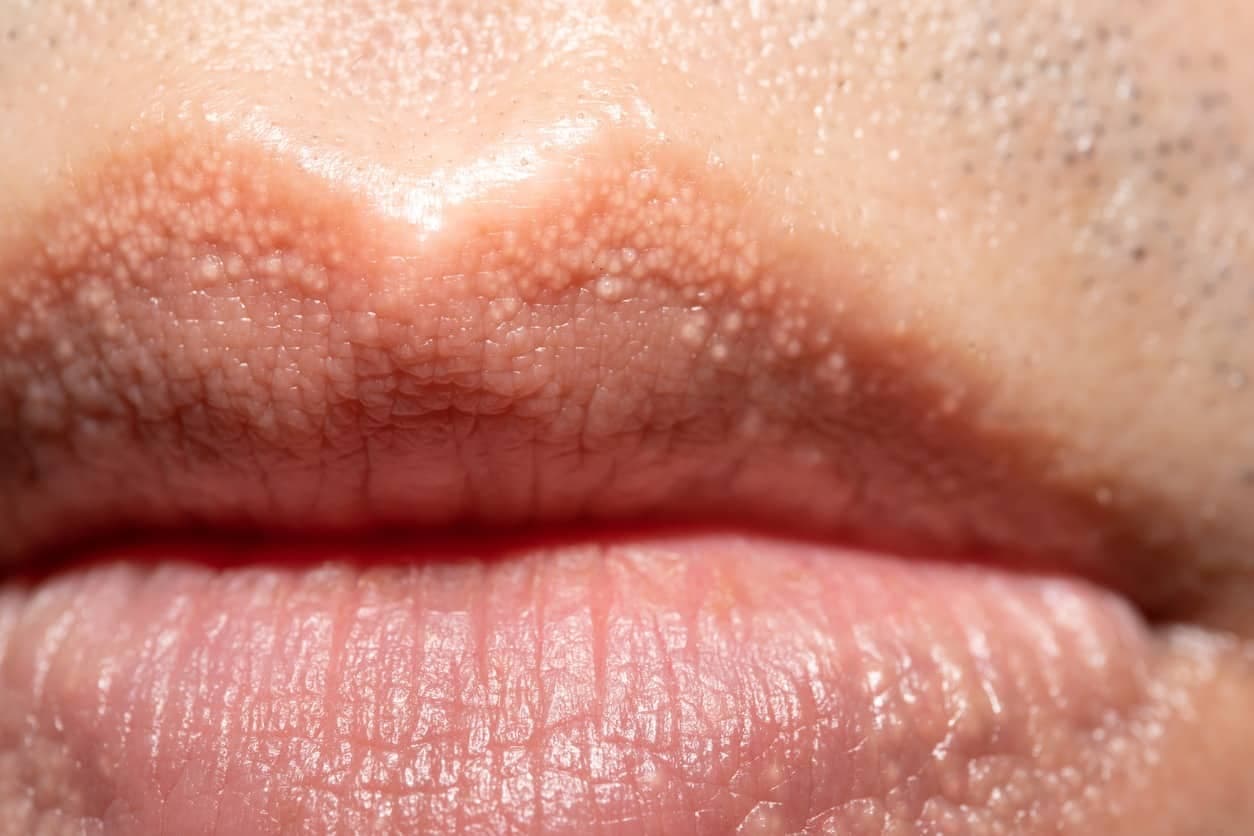
Fordyce spots, also called Fordyce granules, are small, pale-yellow or white bumps on the edge of the lips, inside the cheeks or on the genitals. They are ordinary oil (sebaceous) glands that happen to sit where there are no hair follicles, so they open directly onto the surface and show through the thin skin. Around 70–80% of adults have them. They are not an infection, not sexually transmitted, not contagious and not a sign of cancer. No treatment is needed; procedures exist only for people who dislike how they look.
What are Fordyce spots?
Sebaceous glands normally sit beside a hair follicle and empty their oil into it. In a few areas of the body the glands are present without any follicle, mostly on the lip border, the mucous membrane of the cheeks and the genital skin. On the thin, hairless skin of these sites the glands are visible as tiny dots. The American dermatologist John Addison Fordyce described them in 1896.
Because they are normal glands rather than a disease, dermatologists regard Fordyce spots as a normal variant of skin, in the same way that freckles or visible veins are. A few case series have linked unusually numerous spots to Muir–Torre syndrome, a rare hereditary condition, but for the vast majority of people the spots mean nothing at all.
Key facts:
- Prevalence: about 70–80% of adults.
- Onset: probably present from birth, but too small to see; they enlarge and become visible from puberty onwards as hormone levels rise.
- Sex: develop about twice as often in men as in women.
- Nature: benign, non-infectious, painless.
- Why they matter: they are frequently mistaken for genital warts, herpes or other conditions that do need treatment.
Symptoms and where they appear
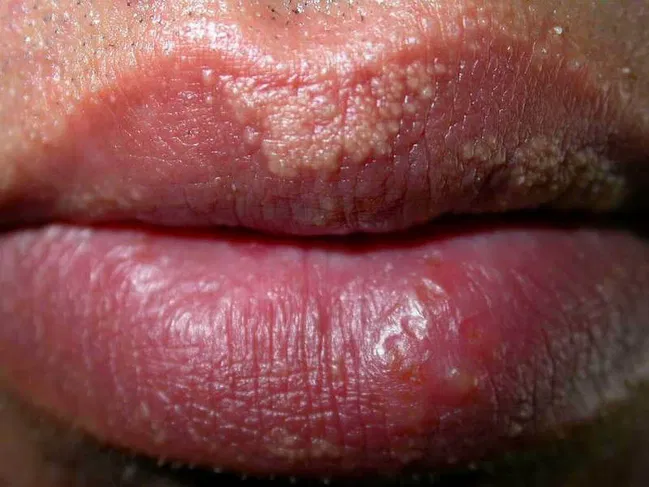
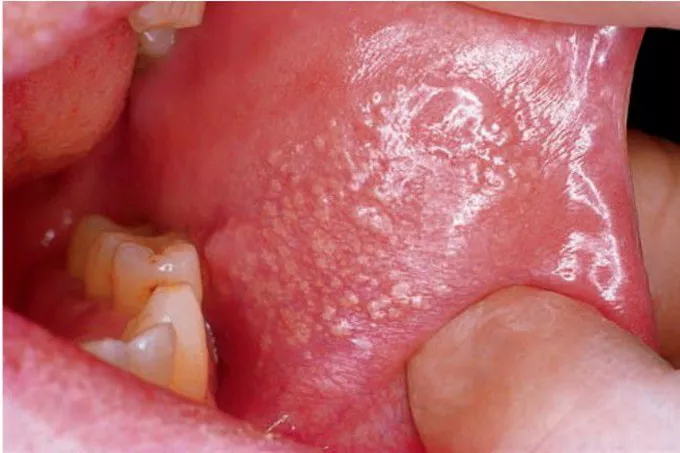
Fordyce spots look like:
- small raised dots, usually 1–3 mm across (occasionally up to 5 mm), from a pinhead to a sesame seed;
- white, yellowish, pale pink or skin-coloured;
- single, in small groups, or in crops of 50–100;
- easier to see when the skin is stretched, when the lips are dry, or under bright light.
Typical locations:
- Lips. The vermilion border, the line where the lip meets facial skin.
- Inside the mouth. The inner surface of the cheeks.
- Genitals. The shaft and head of the penis and the scrotum in men (here they are sometimes called Tyson glands), and the labia in women.
Free sebaceous glands of the same kind also occur around the nipple, where they are called Montgomery glands. They are a related normal finding rather than Fordyce spots.
They cause no pain, itching or discharge. There are some reports of spots on the penis becoming irritated or itchy with friction during sex. They do not bleed, ulcerate or form crusts; if a bump does any of these things, it is not a Fordyce spot.
Causes
Fordyce spots are not caught or acquired. The glands are part of normal anatomy and are probably there from birth. The hormonal changes of puberty make the glands larger and more active, which is why the spots seem to “appear” in the teenage years and are more prominent in men. Dry, chapped lips make existing spots stand out more. They are not caused by poor hygiene, diet, sexual activity, kissing or any infection.
Fordyce spots or something else?
The real medical importance of Fordyce spots lies in telling them apart from conditions that look similar but need treatment:
- Genital warts (HPV). Skin-coloured or pink growths with a rough or cauliflower-like surface that tend to grow and multiply. Fordyce spots are smooth, uniform and unchanging. See viral warts.
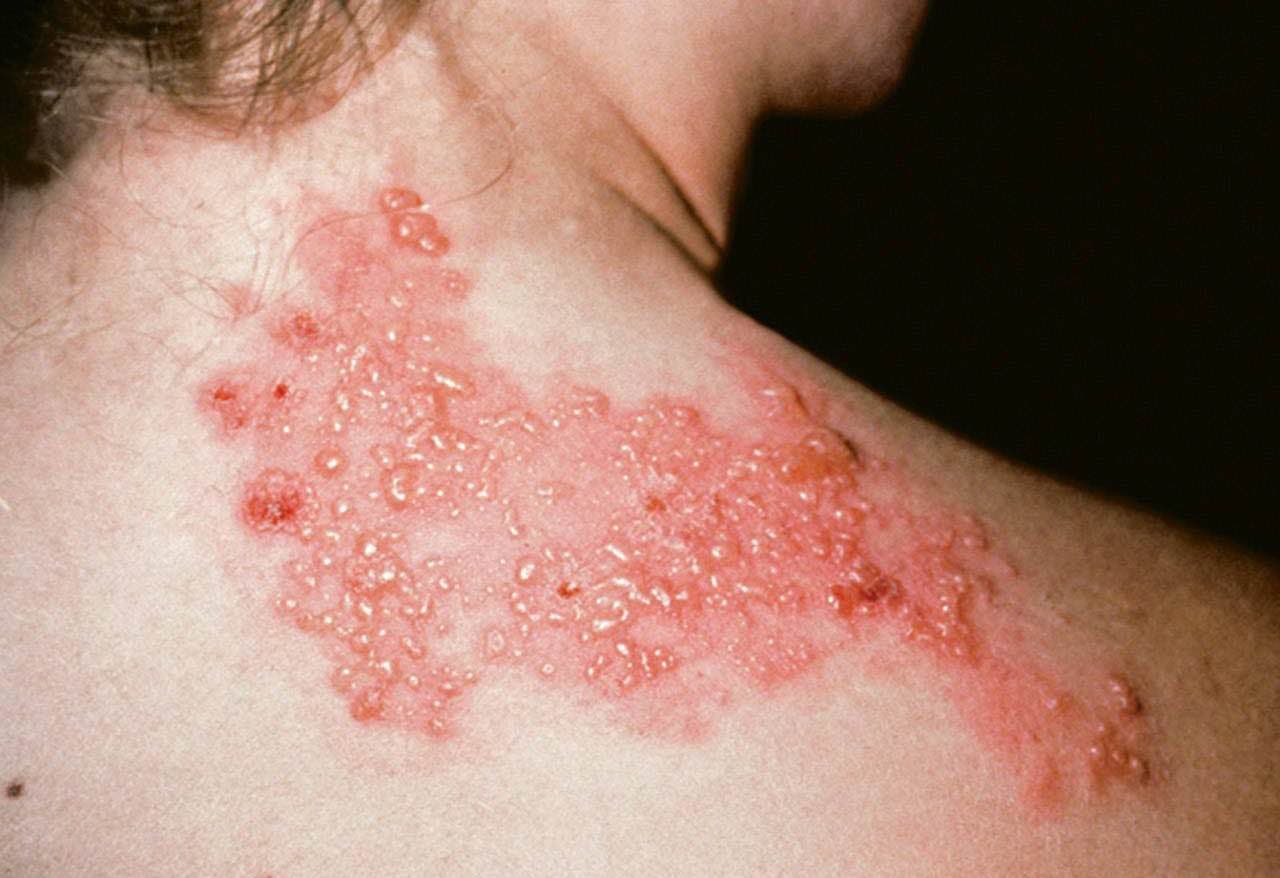
- Genital or oral herpes. Herpes causes painful, fluid-filled blisters that break into sores and heal within one to three weeks, often with tingling beforehand. Fordyce spots never blister or hurt. See herpesvirus infection.
- Molluscum contagiosum. A viral infection with shiny, dome-shaped papules of 1–6 mm that have a small central dimple. Molluscum spreads by skin contact, including sexual contact in adults, and can appear on the genitals or the lips.
- Milia and epidermoid cysts. Milia are tiny white keratin-filled cysts, commonly around the eyes and on the cheeks. Epidermoid cysts are larger, mobile lumps under the skin with a central pore.
- Sebaceous hyperplasia. Enlarged oil glands on the forehead and cheeks of middle-aged adults: yellowish bumps up to 3 mm with a central dip where the hair follicle sits. It is the same kind of gland in a different location, and here a dermatologist sometimes needs to rule out basal cell carcinoma.
- Pearly penile papules. A neat ring of tiny dome-shaped bumps around the rim of the glans. Also harmless, also a normal variant, but distinct from the scattered Fordyce spots on the shaft.
Diagnosis
A dermatologist recognises Fordyce spots by their appearance: uniform small yellow-white dots at a typical site, present for years, with no symptoms. A biopsy is almost never required; when one is taken for other reasons it shows a mature sebaceous gland opening directly onto the surface with no hair follicle attached.
A sudden crop of new bumps on the genitals, bumps that itch, hurt, bleed or change, or any doubt about what they are, is a good reason to have them examined rather than to self-diagnose. Some sexually transmitted infections look like Fordyce spots in their first days, and those need proper treatment.
Do Fordyce spots need treatment?
No. They are harmless, they do not develop into anything else and they do not affect general health. The standard medical advice is to leave them alone and not to pick or squeeze them: squeezing releases a little oil at most, does not make the spots go away, and tends to cause irritation or inflammation that is more visible than the spot was.
Treatment is purely cosmetic and is chosen by people who feel self-conscious about spots on the lips or genitals. Options a dermatologist may offer:
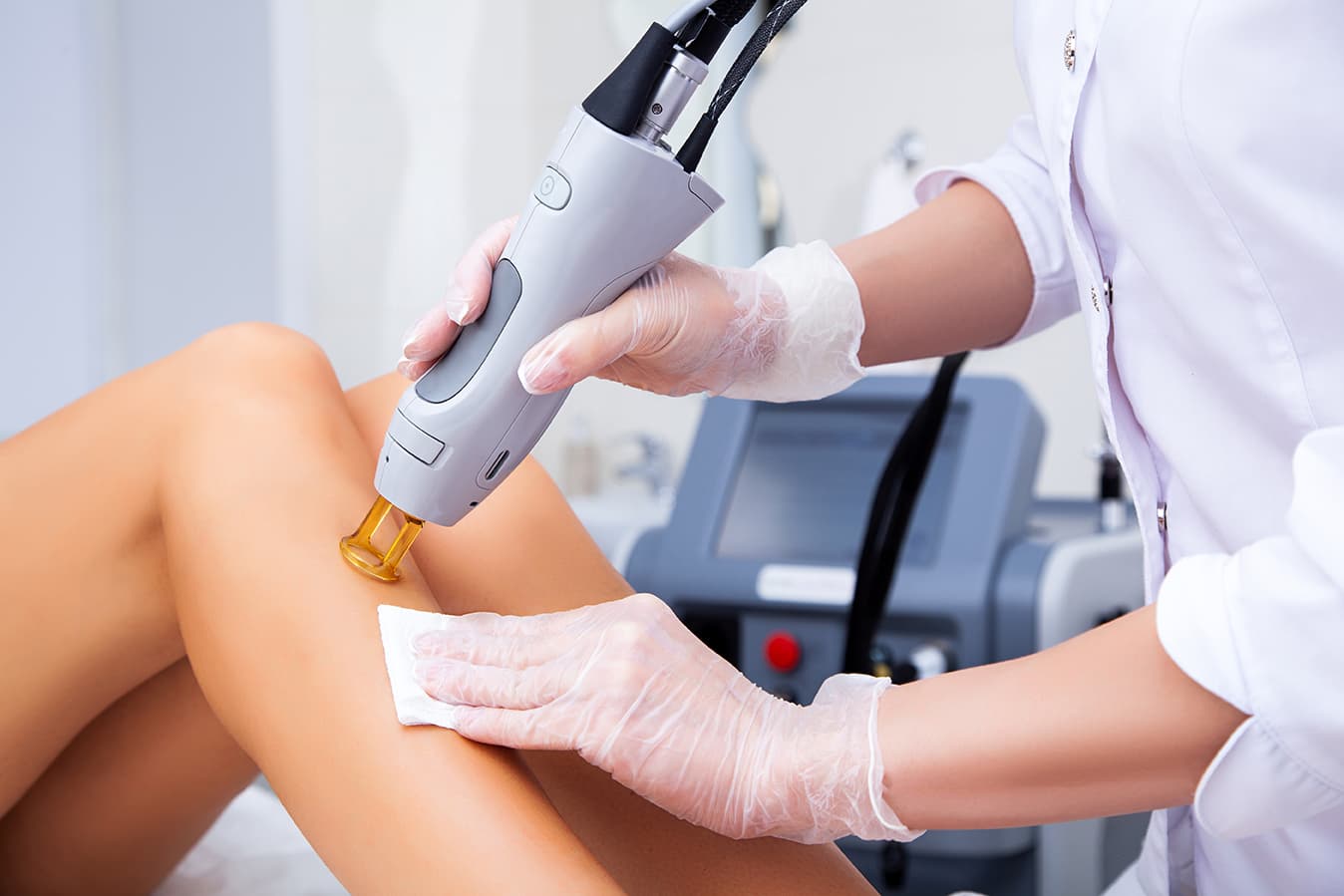
- CO₂ laser vaporisation. Short light pulses remove the gland with little damage to surrounding tissue. The treated area heals in roughly 5–21 days. A faint mark is possible.
- Electrosurgery / electrodesiccation. A fine electric needle destroys each gland. Healing takes about 3–5 days per session.
- Cryotherapy. Freezing with liquid nitrogen. Mild soreness for about three days afterwards.
- Micro-punch excision. Each spot is removed with a tiny circular punch. Healing can take up to a month.
- Topical retinoid creams. A dermatologist may prescribe a vitamin-A-derived cream that can reduce, and sometimes clear, the spots; it takes about 2–6 weeks to see a result.
There is no proven home remedy. Oils, vinegar and exfoliating scrubs do not remove sebaceous glands; at best they moisturise the lips so the spots are a little less noticeable, and at worst they irritate the thin skin. Keeping the lips moisturised and using a mild cleanser is reasonable; nothing more is required.
When to see a dermatologist
- You have new bumps on the genitals and are not sure what they are, especially after a new sexual partner.
- The bumps itch, hurt, bleed, blister, crust, grow or change colour.
- You have Fordyce spots that bother you cosmetically and want to discuss removal.
Confirming the diagnosis is usually quick and can often be done from clear photographs. An online dermatologist consultation is a sensible first step for a lip or genital bump you are unsure about: the doctor can usually tell Fordyce spots from warts, herpes or molluscum, and arrange an in-person visit only if something needs testing or removing.