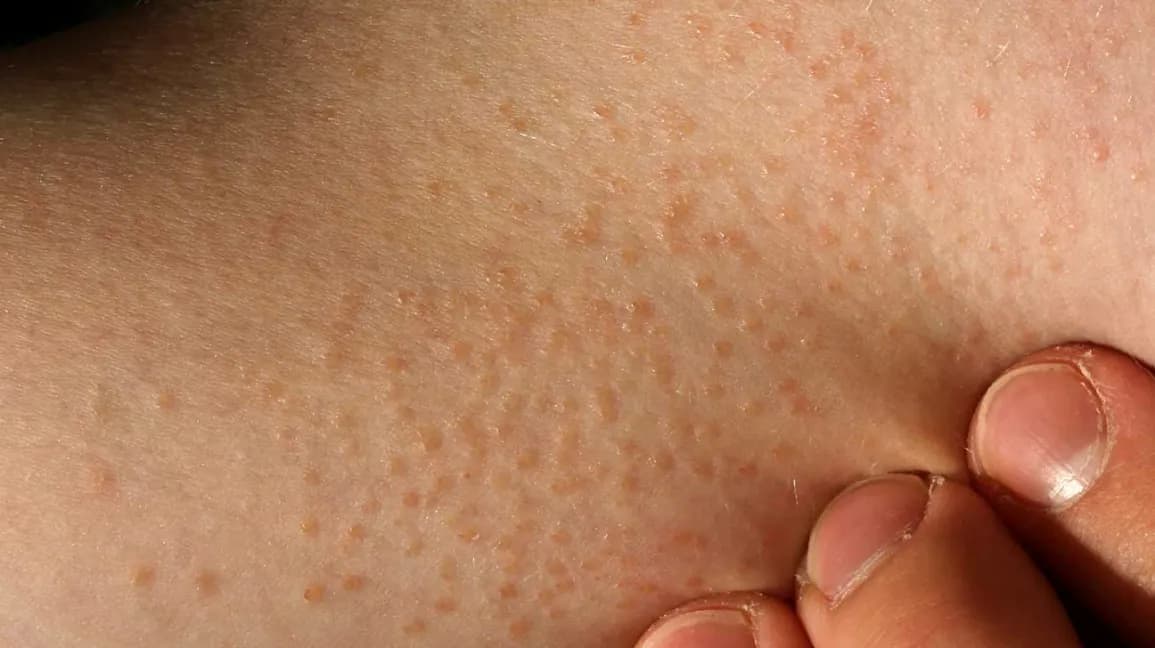
What is lichen nitidus?
Lichen nitidus is an uncommon skin condition that shows up as crops of tiny, shiny, flat-topped bumps, each about the size of a pinhead, and that usually needs no treatment (DermNet, PCDS). It is classed as an inflammatory reaction in the skin, not an infection (DermNet), and no guidance page describes it passing from one person to another. It mostly affects children and young adults, and in most people it clears by itself (DermNet, PCDS). It was once regarded as a variant of lichen planus; DermNet now treats it as a separate condition, although some clinicians still consider it a variant (PCDS).
The bumps are usually symptom-free (DermNet, PCDS). In iDerma's experience, most people seek advice because the rash looks unusual or keeps appearing in new places, not because it hurts or itches.
Who gets lichen nitidus?
- Children and young adults. It usually begins in preschool or school-aged children, or in early adult life (DermNet, PCDS).
- Both sexes equally. It affects males and females alike, and people of every ethnic background (DermNet, PCDS).
- Occasionally several members of one family. DermNet describes it as sometimes familial.
- A palm-only form is the exception to the age rule: it tends to appear between the late thirties and early fifties and is very persistent (DermNet).
What causes lichen nitidus?
The cause is unknown (DermNet, PCDS). It is classed as an inflammatory skin condition rather than an infection (DermNet), and no guidance page describes the bumps being caught from another person or passed on. None of the specialist guidance pages links it to hygiene, diet or any product applied to the skin.
Lichen nitidus has been reported alongside a few other conditions: lichen planus, atopic dermatitis, Crohn's disease, Down's syndrome, HIV infection and juvenile chronic arthritis (DermNet). These are reported associations rather than causes (DermNet).
One pattern is well documented. New bumps often appear in a straight line along a scratch, a graze or a rubbed area. This is the Koebner phenomenon, which is also seen in psoriasis, vitiligo and lichen planus (DermNet). It is the reason to avoid scratching or rubbing the affected skin.
What lichen nitidus looks like
The individual bump is the clue (DermNet, PCDS):
- Size: pinpoint to pinhead, about 1 to 2 mm across (DermNet); PCDS gives 1 to 3 mm.
- Surface: flat-topped, smooth and shiny (PCDS).
- Colour: usually the colour of the surrounding skin; less often yellow, red-brown or violet (DermNet). In brown or black skin the bumps may look paler than the surrounding skin, or darker (DermNet, PCDS).
- Arrangement: the bumps are separate but sit in groups (PCDS), and in places they merge into a flat, slightly raised patch (DermNet).
- Symptoms: usually none. Some people itch, and occasionally the itch is intense (DermNet, PCDS).
Rarely, a bump carries a tiny blister on top or a small central dimple (DermNet).
Where it appears. The usual sites are the inner forearms, the backs of the hands, the chest, the abdomen, the buttocks and the genitals, including the penis (DermNet, PCDS). Any part of the skin can be involved, including the face, and the rash is occasionally widespread (DermNet, PCDS). Over the elbows and knees the grouped bumps can resemble psoriasis (DermNet).
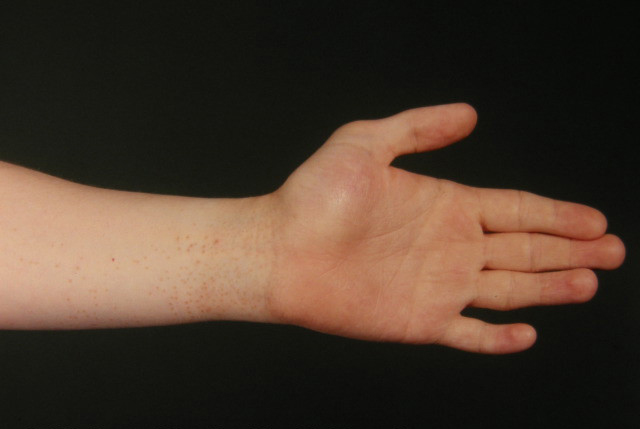
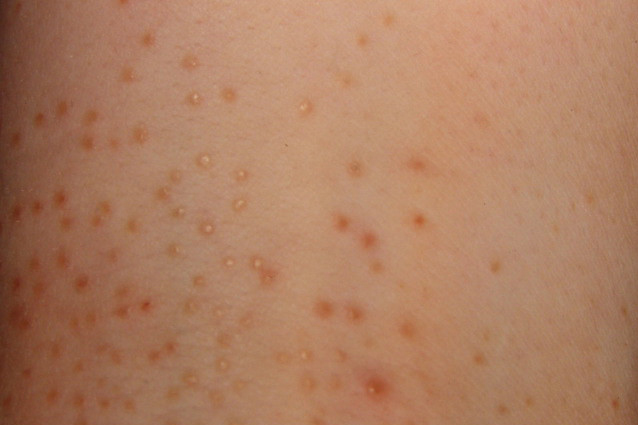
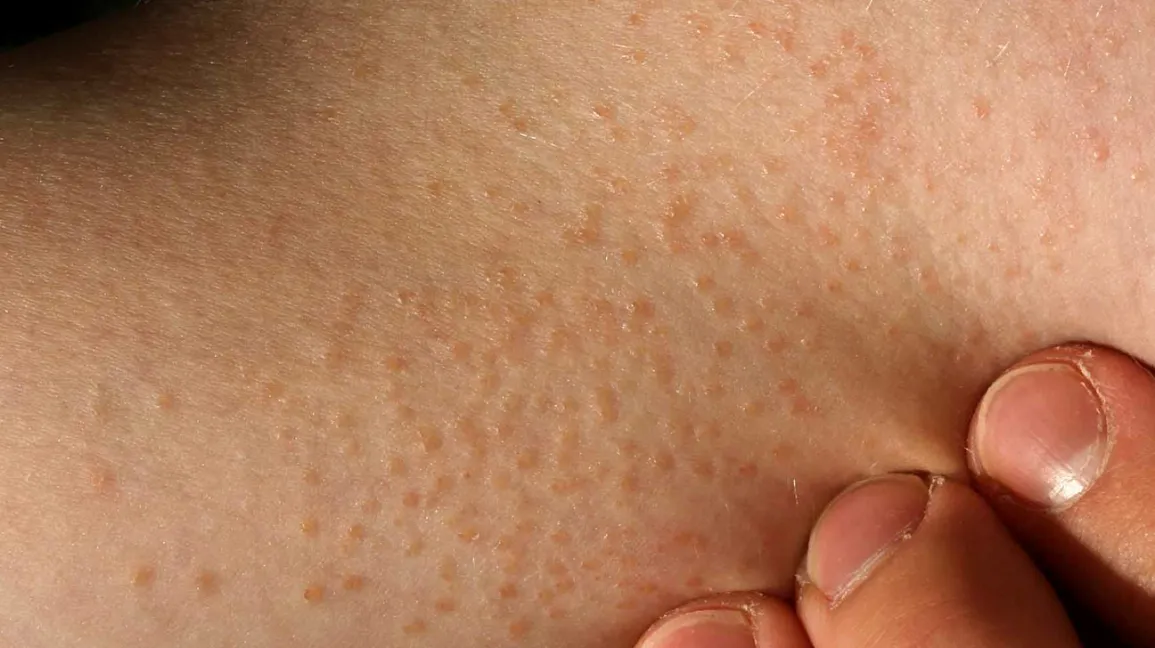
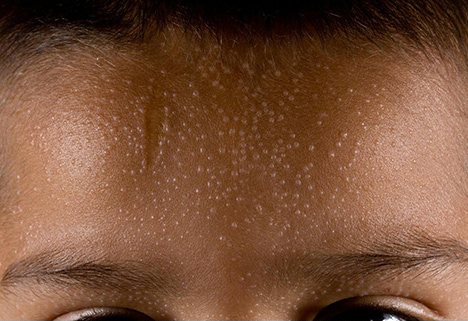
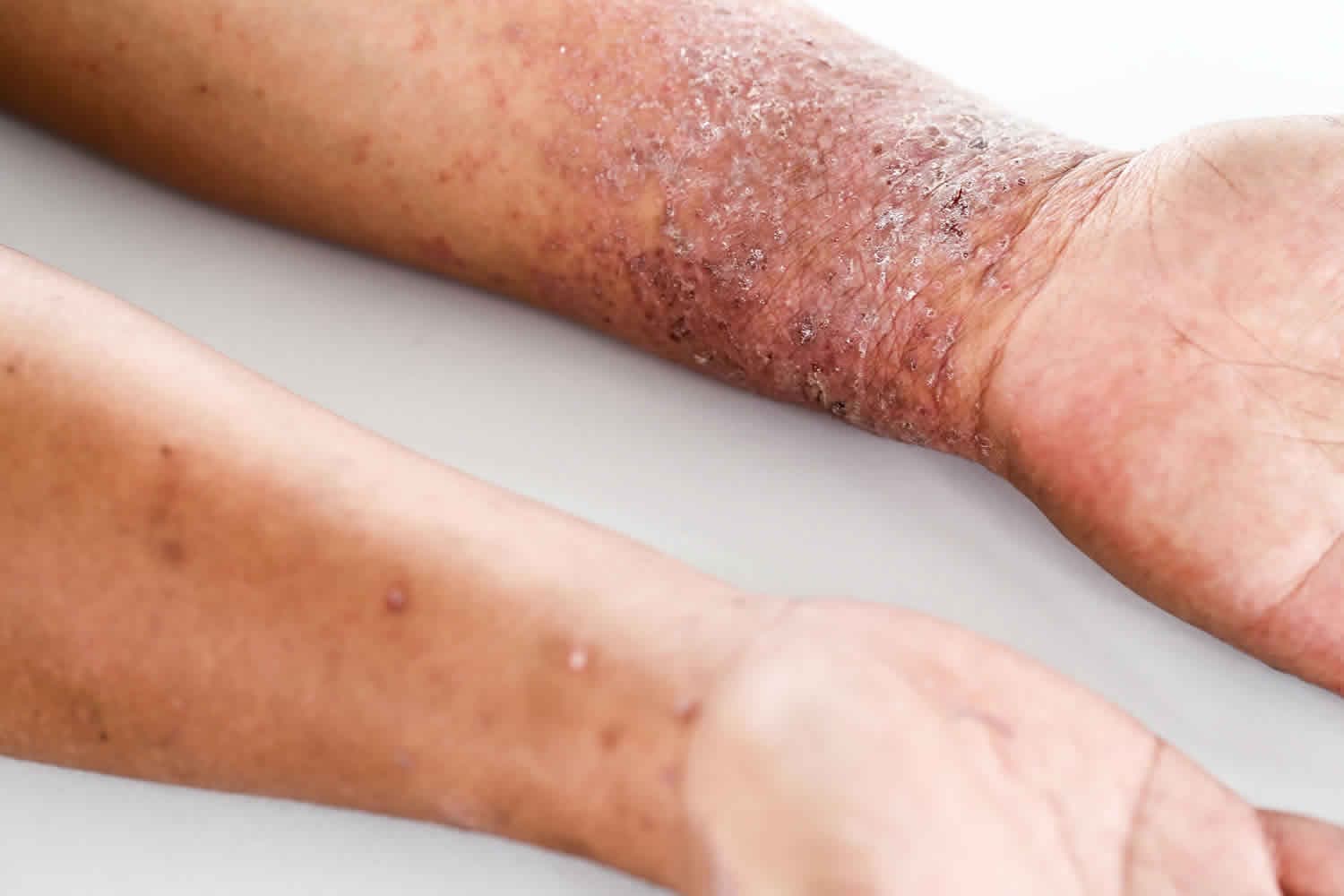
The photographs show typical lichen nitidus: pinhead-sized bumps grouped on the inner wrist, two close-up views of shiny bumps on pale skin, and a child's forehead, where the bumps look paler than the surrounding skin.
Palms, soles, mouth and nails
Lichen nitidus can affect the palms and soles, on one side or both, either alone or together with the typical sites; this form favours an older age group and tends to persist (DermNet). In the mouth it produces tiny grey-white flat bumps inside the cheeks (DermNet, PCDS), or white patches on the tongue and palate, which can be confused with oral lichen planus (DermNet). Nail changes are seen in roughly one person in ten, mostly adults (DermNet): lengthwise ridges, splitting of the free edge or redness of the skin fold at the base of the nail (DermNet), and pitting (PCDS).
Less common forms
- Generalised: bumps across much of the body (DermNet, PCDS).
- Linear: bumps arranged in a line, described as a rare variant independent of the Koebner reaction (PCDS).
- Actinic: on sun-exposed skin, usually in people with darker skin, recurring in summer (DermNet).
- Vesicular: tiny blisters, usually on the palms, which can resemble pompholyx, a blistering hand eczema (DermNet).
- Purpuric: a haemorrhagic form, often starting on the tops of the feet and around the ankles before spreading up the legs (DermNet).
- Keratoderma type: thickened, cracking skin of the palms and soles that resembles chronic eczema (DermNet, PCDS).
- Perforating: dimpled bumps, mostly on the hands and forearms (DermNet).
Lichen nitidus on the face, in children and on the buttocks
Three sites prompt most of the questions iDerma dermatologists receive about this rash.
Face. The face is not one of the classic sites, but it can be involved (DermNet, PCDS). In darker skin the bumps can look paler than the surrounding skin (DermNet, PCDS), and the forehead is one of the sites illustrated in the PCDS image set. Plane warts and milia also favour the face (DermNet), so they are the look-alikes to rule out there; both are described in the table below.
Children. It usually begins in childhood or early adult life (DermNet, PCDS). Because it is an inflammatory condition and not an infection (DermNet), iDerma dermatologists see no reason to keep a child away from nursery, school or swimming. In about two-thirds of cases the rash clears within a year (DermNet).
Buttocks. The buttocks are one of the usual sites (DermNet, PCDS); in iDerma's experience, grouped skin-coloured bumps here are often first noticed at bath time. Friction can provoke new bumps along the line of injury (DermNet), which is worth remembering with nappies, tight waistbands and long periods of sitting.
Is lichen nitidus dangerous?
No. It is an inflammatory skin condition that settles by itself in most people (DermNet, PCDS), and none of the specialist guidance pages describes internal organ involvement or a link to skin cancer. The conditions reported alongside it are associations, not consequences (DermNet). The one lasting effect in some people is a patch of darker skin where the bumps used to be, which can persist for months or, in some cases, years (DermNet); scarring is not described.
How long does lichen nitidus last?
In about two-thirds of people the rash settles within 12 months (DermNet); the rest take longer, and the palm-only form in particular is very persistent (DermNet). The natural course has not been charted in detail (PCDS), so a dermatologist can give the direction of travel but not a date.
After the bumps go, darkening of the skin at the old sites can persist for months or years, particularly in brown and black skin (DermNet). Sunlight makes such marks darker (DermNet), so sunscreen on exposed areas keeps them from deepening while they fade.
What else looks like lichen nitidus?
Several common conditions produce small bumps. The table sets out how a dermatologist tells them apart; a definite answer may still need a biopsy (DermNet).
| Condition | How it differs from lichen nitidus |
|---|---|
| Keratosis pilaris | Rough, dry bumps centred on hair follicles, mainly on the outer upper arms and thighs; very common and often worse in winter (DermNet, NHS), and linked to atopic eczema (DermNet). Lichen nitidus bumps are smooth and shiny rather than rough (PCDS). |
| Lichen planus | Larger, flat-topped, purple or violet bumps and plaques crossed by fine white lines (DermNet, NHS), often very itchy (NHS), typically on the wrists, lower back and ankles (DermNet). The two conditions can occur together (PCDS). |
| Plane warts | Multiple small flat-topped skin-coloured bumps on the face, hands and shins, caused by a wart virus; on the shins and the beard area they are often spread by shaving (DermNet). Warts are infectious, whereas lichen nitidus is classed as inflammatory, not infectious (DermNet). |
| Molluscum contagiosum | White, pink or brown dome-shaped bumps of 1 to 6 mm with a waxy shine and a small central pit, often in the armpits, behind the knees or in the groin (DermNet); a viral infection passed on by skin contact (NHS). |
| Milia | Tiny pearly-white keratin cysts just under the skin surface, most often on the eyelids and cheeks; seen at any age (DermNet). |
| Lichen spinulosus | Round or oval patches of small rough bumps, each with a tiny horny spine, which feel like a nutmeg grater; a variant of keratosis pilaris (DermNet). |
| Lichen striatus | Pink or red spots that join within a week or two into a single, slightly scaly band running along one arm or leg, mainly in children (DermNet). |
How lichen nitidus is diagnosed
A dermatologist will usually suspect lichen nitidus from the size, shine and grouping of the bumps and from where they sit, the features by which the guidance pages describe it (DermNet, PCDS). Because so many small-bump conditions overlap, the diagnosis is usually confirmed with a skin biopsy (DermNet): a few millimetres of skin are removed under a local anaesthetic injection, which stings briefly, and the sample is examined under a microscope (DermNet). The appearance under the microscope is described as a claw-and-ball pattern (DermNet).
Dermoscopy, a magnified examination with a hand-held lens, is a routine part of assessing small skin lesions (DermNet). In keratosis pilaris it shows abnormal hair shafts inside the bumps (DermNet), which helps separate the two. None of the guidance pages describes a blood test for lichen nitidus.
Online assessment. Sharp close-up photographs in daylight, together with the history (when it started, whether it itches, whether anyone else in the family has it, any mouth or nail changes), let an iDerma dermatologist say whether the picture fits lichen nitidus or one of its look-alikes, and whether a biopsy is worth arranging.
Treatment of lichen nitidus
Most people need no treatment at all: the bumps cause no symptoms and usually clear on their own (DermNet, PCDS). Treatment is considered when the rash itches, is widespread, sits on a visible site such as the face or hands, or has lasted a long time (DermNet). Even then the response is unpredictable (PCDS); the options below are the ones reported to have helped some patients (DermNet, PCDS).
Options a dermatologist may discuss:
- Protecting the skin from scratching and friction, because injury provokes new bumps (DermNet).
- Moisturisers, which soothe and hydrate dry or itchy skin (NHS).
- A steroid cream for a short, supervised course when itch or inflammation is troublesome; some rashes have responded to it, others have not (PCDS).
- Steroid-free anti-inflammatory creams, a prescription class, which have been reported to help (DermNet).
- Light treatment. Sunlight, or ultraviolet light delivered in a dermatology department, has been reported to help in some cases (DermNet, PCDS). It is not the option for the actinic form, which sun exposure brings on (DermNet).
- Tablet treatment in severe cases, including an antihistamine, which only a dermatologist would decide on (DermNet).
What does not help. Neither specialist guidance page (DermNet, PCDS) lists a diet, supplement, scrub or home remedy for lichen nitidus. Picking or scrubbing the bumps risks a new line of them along the injured skin (DermNet). Over-the-counter antifungal and wart products are made for infections; lichen nitidus is an inflammatory condition, not an infection (DermNet), so they have nothing to act on.
Daily care
- Wash with a soap substitute or a mild, fragrance-free cleanser and apply a plain moisturiser afterwards; creams suit daytime use and ointments suit very dry skin at night (NHS).
- Keep nails short and avoid rubbing, picking or scrubbing the area, so that no new bumps form along scratch lines (DermNet).
- Where the rash sits in a friction zone such as the waistband or the buttocks, choose soft, loose clothing.
- Use sunscreen on exposed affected areas. It stops post-inflammatory marks darkening (DermNet) and matters most in the actinic form, which sun exposure brings on (DermNet). Deliberate sunbathing to treat the rash should only follow a dermatologist's advice, because light is both a reported treatment and, in the actinic form, the trigger (DermNet).
When to see a dermatologist
- You are not sure what the bumps are; warts, molluscum and eczema each need different handling.
- The rash itches or has become widespread (DermNet), or it is spreading quickly.
- Bumps or white patches appear in the mouth, on the palms or soles, or the nails change (DermNet, PCDS).
- It has not cleared after 12 months (DermNet), or it keeps coming back.
- The bumps sit on the face or hands and bother you, or dark marks remain after they have gone (DermNet).
- You also have lichen planus, an inflammatory bowel condition or another condition reported alongside lichen nitidus (DermNet).
An online consultation with an iDerma dermatologist covers the first step: confirming from photographs whether the rash fits lichen nitidus, deciding whether a biopsy is needed, and agreeing a care plan that suits the person's age, skin type and the sites involved.
What to do now
Photograph the bumps in daylight, including one close-up with a coin or ruler for scale, and note when they started, whether they itch, and whether a line of bumps has followed a scratch. Do not pick at them. Send the photographs to an iDerma dermatologist: if the picture fits lichen nitidus, the usual advice is gentle skin care and patience, and if a biopsy or prescription treatment is worth considering you will be told exactly what to ask for.