What perioral dermatitis is
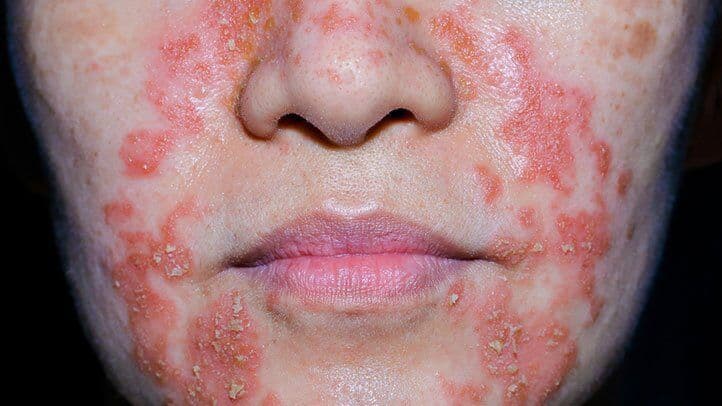
Perioral dermatitis is a common, long-lasting rash of tiny red bumps and flaky patches around the mouth, often spreading to the folds beside the nose and sometimes to the skin around the eyes. 'Perioral' means around the mouth; because the same rash can sit around the nostrils, the eyes or, rarely, the genitals, dermatologists increasingly call it periorificial dermatitis (around the openings) (DermNet periorificial dermatitis, AAD). It is not an infection and it is not acne, although it is mistaken for both.
It mostly affects women between 20 and 50, in all skin types (BAD peri-oral dermatitis), but children from about seven months to 13 years get it too (DermNet periorificial dermatitis). The most common trigger is a steroid medicine reaching the facial skin: a steroid cream, a nasal spray or an inhaler (DermNet periorificial dermatitis, BAD peri-oral dermatitis, MedlinePlus). The rash tends to come in waves over months, so treatment is planned over weeks rather than days.
Key facts
- It is not contagious: you cannot catch it or pass it on (AAD).
- Left alone it usually runs a chronic, variable course lasting months to years; mild cases can clear once every irritant and steroid is stopped, and it usually responds well to treatment (DermNet periorificial dermatitis).
- With the right treatment most people clear within several weeks to a few months, and the rash usually stays away as long as steroid creams are kept off the face (BAD peri-oral dermatitis, AAD, MedlinePlus).
- It rarely scars or changes skin colour, except in the severe 'lupoid' form and in the granulomatous childhood variant (DermNet periorificial dermatitis, JAAD Int 2025 cohort).
- In children, steroid nasal sprays and inhalers for hay fever or asthma are linked to about three times the rate of new diagnoses within six months (Pediatric Dermatology 2026 TriNetX study).
What it looks like
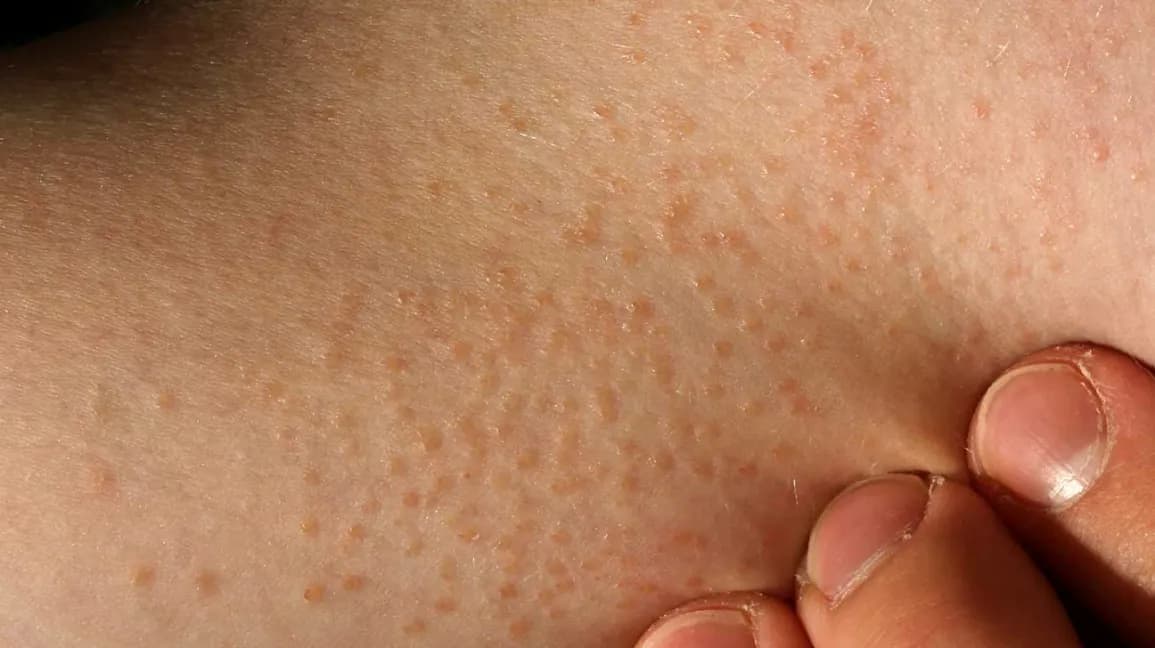
The typical picture is a cluster of small bumps, usually under 2 mm across, pink or red on lighter skin and skin-coloured, pink, purple or slightly darker than the surrounding skin on brown or black skin (DermNet periorificial dermatitis, BAD peri-oral dermatitis, AAD). Some bumps hold a tiny drop of fluid or pus. The skin between them is often dry, flaky and tight, and the area may sting or burn; itch is usually mild and pain is rare (DermNet periorificial dermatitis).
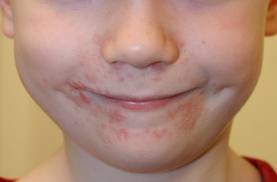
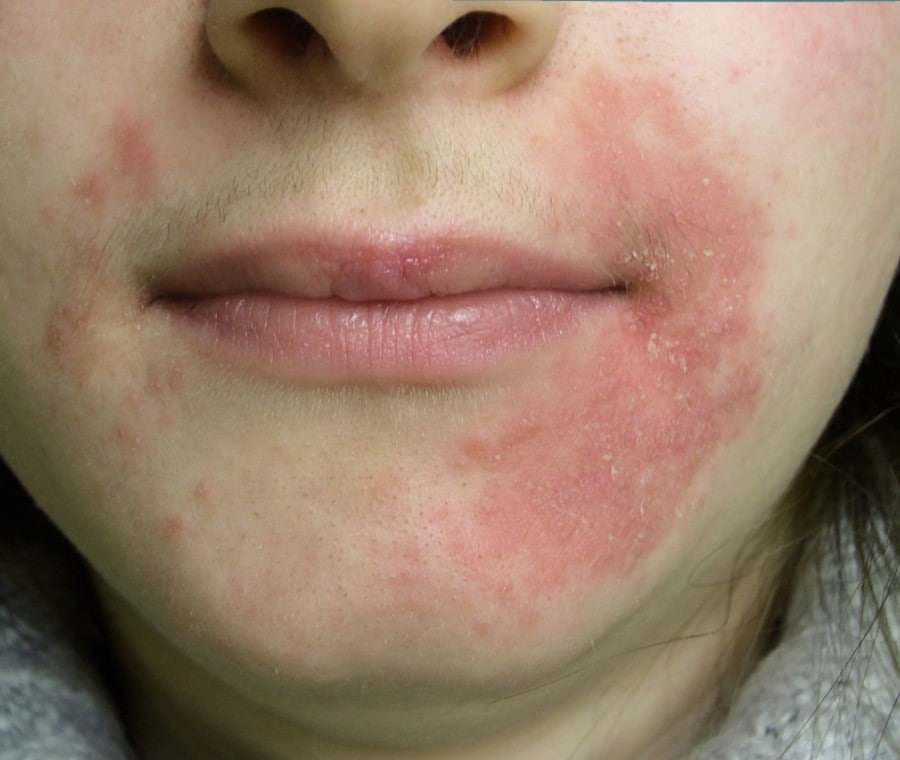
The most useful clue is the narrow rim of normal skin right next to the lips: the rash stops a few millimetres short of the lip border, as both photographs above show. Only in severe cases does it reach the lips themselves (DermNet periorificial dermatitis). From the chin it commonly spreads into the nasolabial folds and around the nostrils; a rash around the nose alone is the same condition under a different name, perinasal dermatitis. The eyelids and the skin beside the eyes can be involved on their own (periocular dermatitis) or together with the mouth. The cheeks and forehead are usually spared, which separates it from rosacea (BAD peri-oral dermatitis, PCDS rosacea).
Severe forms: In 'lupoid' perioral dermatitis the bumps are larger, denser and red-brown, and this form can scar (DermNet periorificial dermatitis). Childhood granulomatous periorificial dermatitis is a rare variant seen more often in children with darker skin: uniform dome-shaped skin-coloured, red or yellow-brown bumps, usually without pus, sometimes also on the neck, chest and limbs, nearly always after a steroid has been used. In a 2025 series of 43 children, about 15% scarred, all of them moderate-to-severe cases, so this variant is treated promptly (DermNet periorificial dermatitis, JAAD Int 2025 cohort).
Causes and triggers
No single cause has been proven. The best-supported idea is that the skin barrier around the mouth breaks down: water escapes, the skin feels tight and dry, the person applies more creams, more irritants get in, and inflammation follows (DermNet periorificial dermatitis, DermNet skin barrier function). Whatever starts the cycle, several factors reliably feed it:
- Steroids by any route: steroid creams on the face are the commonest trigger, including the mild one sold without prescription (AAD, BAD peri-oral dermatitis, NHS steroids). Steroid nasal sprays and inhalers count too: in a matched study of more than 500,000 children with hay fever or asthma (252,200 per group), those using steroid sprays or inhalers were about 3.3 times as likely to be diagnosed with perioral dermatitis within six months and 2.3 times at one year, while non-steroid sprays carried no extra risk (Pediatric Dermatology 2026 TriNetX study). Steroid tablets can do the same (BAD peri-oral dermatitis). Typically the cream calms the rash at first, then the rash returns worse each time it is stopped (AAD).
- Heavy, greasy or layered skincare: Thick occlusive ointments and heavy creams are listed risk factors, as are cosmetics in general (DermNet periorificial dermatitis, MedlinePlus, DermNet emollients). Harsh cleansers, acids, scrubs and strongly scented products damage the barrier further (DermNet irritant contact dermatitis, DermNet fragrance allergy).
- Sunscreen, particularly thick physical (mineral) sunscreens in children (DermNet periorificial dermatitis, MedlinePlus).
- Toothpaste and dental products: certain toothpastes and dental fillings are listed irritants or allergens, with fluoridated and strongly flavoured pastes the usual suspects (DermNet periorificial dermatitis, MedlinePlus, DermNet fragrance allergy).
- Hormones: Flares before periods, during pregnancy and with the contraceptive pill have been observed (DermNet periorificial dermatitis, MedlinePlus).
- Sensitive or atopic skin: People with atopic eczema or a sensitive skin barrier are more prone (DermNet periorificial dermatitis, DermNet atopic dermatitis).
- Weather: Sun, heat and wind seem to worsen it (DermNet periorificial dermatitis).
- Microbes: Demodex mites, yeasts and certain bacteria have been grown from the bumps, but whether they cause anything is unclear (DermNet periorificial dermatitis, DermNet demodex).
Usually several of these act together: a barrier that was already fragile, plus one steroid cream too many.
Is perioral dermatitis contagious?
No. Wherever it appears, around the mouth, nose, eyes or genitals, it cannot be caught from or given to another person (AAD). Sharing towels, kissing or close contact does not spread it. The common look-alikes that are contagious are impetigo, cold sores and ringworm of the face, which is why golden crusts, grouped blisters or a spreading scaly ring change the diagnosis (NHS impetigo, NHS cold sores, DermNet tinea faciei).
Can perioral dermatitis go away on its own?
It sometimes does, but slowly and not reliably. Without treatment the rash typically runs a chronic, fluctuating course that can last months to years (DermNet periorificial dermatitis). What does often clear a mild case is 'zero therapy': stopping every cream, cosmetic, sunscreen and steroid on the face and washing with water alone (DermNet periorificial dermatitis, MedlinePlus). It is advised for everyone, and some people need nothing more (DermNet periorificial dermatitis). Two warnings: expect a temporary flare after a steroid cream is stopped, and do not restart the steroid to settle that flare, because each restart resets the cycle (AAD, MHRA). If the rash does not settle on strict zero therapy, or is spreading, severe or near the eyes, it is time for treatment (DermNet periorificial dermatitis, MedlinePlus).
Acute or chronic?
It is chronic and relapsing. Individual bumps come and go over days, but the condition itself lasts weeks to months per episode and can recur, especially if steroid creams are used again (DermNet periorificial dermatitis, MedlinePlus). Once treated, most people stay clear as long as steroid creams are kept off the face, although it can come back (BAD peri-oral dermatitis).
Rashes that look like perioral dermatitis
Getting the diagnosis right matters because two of the look-alikes are treated with the very steroid creams that make perioral dermatitis worse (DermNet periorificial dermatitis, BAD topical steroids):
| Condition | How it differs |
|---|---|
| Rosacea | Centres on the cheeks, nose, forehead and chin, usually after 30, with flushing, persistent redness and visible vessels; it classically spares the skin right around the mouth and eyes, the opposite of perioral dermatitis (DermNet rosacea, PCDS rosacea, BAD rosacea). Steroid creams worsen both, and a steroid-induced rosacea-like rash on the mid-face is a close cousin (DermNet steroid rosacea). |
| Acne and adult acne | Blackheads and whiteheads, deeper nodules, oily skin, and spots on the forehead, cheeks, chest and back; perioral dermatitis has no blackheads (DermNet acne vulgaris, BAD acne, HSE acne, DermNet periorificial dermatitis). |
| Seborrhoeic dermatitis | Thin, flaky salmon-pink patches in the eyebrows, hairline, scalp, beside the nose and on the chest; flaking rather than bumps (DermNet seborrhoeic dermatitis). |
| Contact dermatitis | Irritant or allergic reaction to a product, often itchier and more eczema-like, with swelling and sometimes blisters; a reaction to lipstick, lip balm, toothpaste flavour or a new cream can sit around the mouth, and patch tests tell the two apart (DermNet allergic contact dermatitis, DermNet cheilitis, DermNet patch tests, NHS contact dermatitis, HSE contact dermatitis). |
| Lip-licking dermatitis and angular cheilitis | Saliva irritation gives a sharp-edged red, chapped band on the lips and the skin immediately around them, or cracked corners of the mouth; perioral dermatitis spares that zone (DermNet angular cheilitis, DermNet irritant contact dermatitis). |
| Impetigo | Weeping sores that dry into golden-brown crusts, spreading fast and highly contagious, common around the nose and mouth of children (NHS impetigo, HSE impetigo, DermNet impetigo). |
| Cold sores (herpes simplex) | A tingling, burning patch followed within 48 hours by a tight group of small blisters that crust and heal in about 10 days (NHS cold sores, DermNet herpes simplex). |
| Fungal infection of the face (tinea faciei) | One or a few asymmetrical rings with a scaly edge and a clearer centre, sometimes caught from a pet; steroid creams make it spread and disguise it, and a skin scraping confirms it. 'Fungal perioral dermatitis' usually means this, or the yeast overgrowth sometimes grown from the bumps (DermNet tinea faciei, DermNet periorificial dermatitis). |
| Demodex overgrowth | Rough, sandpaper-like follicular scale, redness and sensitivity on the cheeks and around the eyes; mite numbers are also raised in some cases of perioral dermatitis (DermNet demodex). |
| Steroid rosacea and topical steroid withdrawal | After weeks or months of a steroid cream on the face: confluent burning redness, bumps and visible vessels on the cheeks and forehead that flare badly when the cream is stopped (DermNet steroid rosacea, DermNet topical steroid withdrawal, MHRA). |
| Eyelid eczema | Red, scaly, swollen eyelids from cosmetics, nail products or irritants, without the typical bumps (DermNet eyelid contact dermatitis). |
Why steroid creams make it worse
A steroid cream narrows blood vessels and suppresses inflammation, so the rash fades within days. When the cream is stopped the vessels open again, the suppressed inflammation returns and the skin, now thinner and more fragile, flares harder; most people reach for the cream again, and the cycle repeats (AAD, DermNet topical steroid withdrawal). Potent steroid creams applied to facial skin for weeks are a recognised cause of perioral dermatitis in adults and children, and the thin skin of the eyelids absorbs the most (DermNet topical steroid). Perioral dermatitis is therefore listed among the conditions steroid creams can worsen (BAD topical steroids).
What to do with the steroid depends on who prescribed it and why (AAD, DermNet periorificial dermatitis, MHRA):
- A cream you bought yourself: stop it. Expect a temporary flare, manage it with the care routine below, and if the skin worsens within two weeks of stopping, seek advice rather than restarting the cream (AAD, MHRA).
- A cream prescribed for eczema or another condition: ask the prescriber before stopping. A dermatologist may step down to a weaker cream and then withdraw it, or switch to a non-steroid anti-inflammatory cream, to soften the rebound.
- A steroid inhaler or nasal spray you need for asthma or allergic rhinitis: keep using it, and rinse your mouth and wash the skin around your nose and mouth after each dose. Recovery takes longer while the spray continues, but stopping asthma treatment is far more dangerous than a rash (DermNet periorificial dermatitis).
One rule of thumb: if your skin gets worse within two weeks of stopping a steroid cream, do not restart it without talking to a doctor (MHRA).
When to see a doctor
- Red bumps around the mouth or nose that do not go away after you have stopped all creams and cosmetics, or that are spreading (MedlinePlus, DermNet periorificial dermatitis).
- You have been using a steroid cream, inhaler or nasal spray and the rash appeared or worsened: the plan for the steroid needs a prescriber's input (AAD, DermNet periorificial dermatitis).
- The rash is around the eyes, and especially if the eye itself becomes painful, red, gritty, sensitive to light or your vision blurs: a painful red eye with these features needs urgent assessment the same day whatever the cause (NHS rosacea, HSE rosacea).
- Golden crusts, weeping sores or grouped blisters: these suggest impetigo or a cold sore, which are treated differently and are contagious (NHS impetigo, NHS cold sores).
- The rash is in a child, particularly a child with darker skin and uniform skin-coloured bumps, because the granulomatous variant can scar if left untreated (JAAD Int 2025 cohort).
- You are pregnant, since treatment choices are narrower (DermNet periorificial dermatitis).
- Larger, dense, red-brown bumps, which may be the scarring lupoid form (DermNet periorificial dermatitis).
How it is diagnosed
Perioral dermatitis is a clinical diagnosis: the pattern of small bumps and scale around the mouth with a spared rim at the lips, the history of what has been applied to the face, and a check for steroid exposure by any route are usually enough (DermNet periorificial dermatitis, BAD peri-oral dermatitis). Tests are reserved for doubt (DermNet periorificial dermatitis):
- A swab or skin scraping if impetigo, a yeast or a fungal ring is possible.
- Patch testing if an allergy to a cosmetic, lip product or toothpaste ingredient is suspected; patches are worn on the back for 48 hours and read at 96 hours (DermNet patch tests).
- A skin biopsy, rarely, when the bumps are atypical or granulomatous disease needs confirming.
Treatment, by approach
Treatment removes what feeds the rash, calms the inflammation and then keeps the barrier intact. Courses usually run for four to eight weeks, some people need tablets for two to three months or longer, and stopping too early is one reason the rash comes back (DermNet periorificial dermatitis, MedlinePlus, BAD peri-oral dermatitis).
- Zero therapy: Stop all facial cosmetics, creams, sunscreens and steroid preparations; wash with lukewarm water alone until the rash settles, then move to a gentle non-soap cleanser. If the skin feels tight, use a bland, light moisturiser without fragrance or preservatives, never a thick occlusive ointment. If you must be in the sun, choose a gel or fluid sunscreen rather than a cream (DermNet periorificial dermatitis, BAD peri-oral dermatitis, MedlinePlus).
- Deal with the steroid as described above: stop, step down, or continue a necessary inhaler with rinsing (DermNet periorificial dermatitis, AAD).
- Prescription creams or gels for mild to moderate rash. Dermatologists use antibiotic-type creams and gels, or a non-steroid anti-inflammatory cream of the kind used for facial eczema, for about four to eight weeks. Sensitive facial skin does not always tolerate them, and they may be rotated if one does not help (DermNet periorificial dermatitis, MedlinePlus).
- Antibiotic tablets for moderate to severe, widespread or stubborn rash, and for the granulomatous childhood form. The usual first choice is a once-daily tablet from the antibiotic family also used for acne and rosacea, taken for several weeks and sometimes for two to three months or longer; the response is usually quick. Children under eight and pregnant women are given a different antibiotic family instead (DermNet periorificial dermatitis, BAD peri-oral dermatitis, MedlinePlus). In the 2025 childhood granulomatous series, 95% of children had cleared at six months after treatment with one such alternative (JAAD Int 2025 cohort).
- Refractory cases: A dermatologist may combine a cream with tablets, or for the rare resistant adult case consider the vitamin-A-derived tablet used for severe acne; evidence for it here is limited (DermNet periorificial dermatitis).
What to expect: Improvement is gradual: a few weeks for the first change, a few months for complete clearing (AAD, BAD peri-oral dermatitis). A temporary flare after stopping a steroid is common and does not mean the plan is wrong (AAD, DermNet periorificial dermatitis). Once clear, the rash usually stays away provided steroid creams are kept off the face, and if it does return the same treatment can be repeated (BAD peri-oral dermatitis, DermNet periorificial dermatitis).
Skincare while it clears, and afterwards
- Cleanse once or twice a day with lukewarm water or a mild fragrance-free, non-soap cleanser; no scrubs, acids, exfoliating pads or toners (BAD peri-oral dermatitis, DermNet periorificial dermatitis, AAD).
- Moisturise only if the skin feels tight, with a light, bland, unperfumed product; avoid greasy ointments on the face (DermNet periorificial dermatitis, NHS emollients, DermNet emollients).
- Reintroduce products one at a time once the rash has gone, so a culprit shows itself; a suspect product can be tested by applying it twice a day to a small area of forearm for five to ten days (DermNet patch tests).
- Toothpaste is a listed trigger, so a plain, mild paste and rinsing the skin around your mouth after brushing are sensible precautions, although neither has been formally tested (MedlinePlus, DermNet periorificial dermatitis).
- Wear no make-up during zero therapy. Afterwards, choose light, fragrance-free, non-comedogenic products and remove them gently in the evening (AAD, NHS acne).
- Stay in the shade and wear a hat during the flare; later use a light gel or fluid SPF 30 sunscreen, because sun and heat worsen the rash and sunlight darkens any marks left behind (DermNet periorificial dermatitis, DermNet postinflammatory hyperpigmentation, NHS sunscreen).
- Do not pick or squeeze the bumps (BAD peri-oral dermatitis).
Perioral dermatitis in children
Children from infancy to the early teens get the same rash, and the trigger is even more often a steroid: a cream for eczema in children, a nasal spray for hay fever or an inhaler for asthma (DermNet periorificial dermatitis, NHS atopic eczema, Pediatric Dermatology 2026 TriNetX study). Dribbling and lip-licking irritate the skin around a toddler's mouth, but they cause a chapped lip-licker's rash rather than the bumps of perioral dermatitis (DermNet irritant contact dermatitis). Treatment follows the same steps with gentler choices: zero therapy, a plan for the steroid agreed with the prescriber, a prescription cream, and for widespread or granulomatous disease an antibiotic family suitable for young children, since the usual adult tablets are avoided under the age of eight (DermNet periorificial dermatitis, JAAD Int 2025 cohort). Never stop a child's asthma inhaler because of a rash.
Perioral dermatitis in pregnancy
Hormonal shifts can bring the rash on or worsen it during pregnancy (DermNet periorificial dermatitis, MedlinePlus). Zero therapy and gentle care can be used at any stage. The usual first-line tablets are not used in pregnancy, so if treatment is needed the dermatologist chooses a cream or the antibiotic family used first in pregnancy (DermNet periorificial dermatitis); tell any doctor treating the rash that you are pregnant or breastfeeding (DermNet periorificial dermatitis).
Preventing a relapse
- Keep steroid creams off the face unless a dermatologist prescribes one for a specific reason and a specific time (MedlinePlus, BAD peri-oral dermatitis).
- Keep the routine short: cleanser, light moisturiser if needed, light sunscreen (DermNet periorificial dermatitis).
- Rinse the mouth and surrounding skin after steroid inhalers or nasal sprays (DermNet periorificial dermatitis).
- Note what you were using when a flare began; a simple product diary helps identify personal triggers.
- If a flare returns, start zero therapy at once and seek review early rather than reaching for an old steroid tube (AAD, MHRA).
What an online consultation can and cannot do
Perioral dermatitis is one of the facial rashes best suited to remote care, because the diagnosis rests on the pattern and the history rather than on tests. With two or three sharp, well-lit photographs of the lower face and a list of everything applied to the skin, including any sprays and inhalers, an iDerma dermatologist can usually confirm the diagnosis, separate it from rosacea, acne, contact dermatitis and impetigo, agree a steroid plan with you and, where needed, prescribe treatment. If a swab, scraping or patch test is required, or an eye is involved, you will be directed to in-person care. You can read how perioral dermatitis treatment online works at iDerma, or if the redness is mainly on the cheeks and nose, how we approach rosacea treatment.
If you have small bumps around your mouth or nose that keep coming back, especially after a steroid cream, book an online consultation. A dermatologist reviews your photographs and history and sends you a treatment plan, usually within hours.