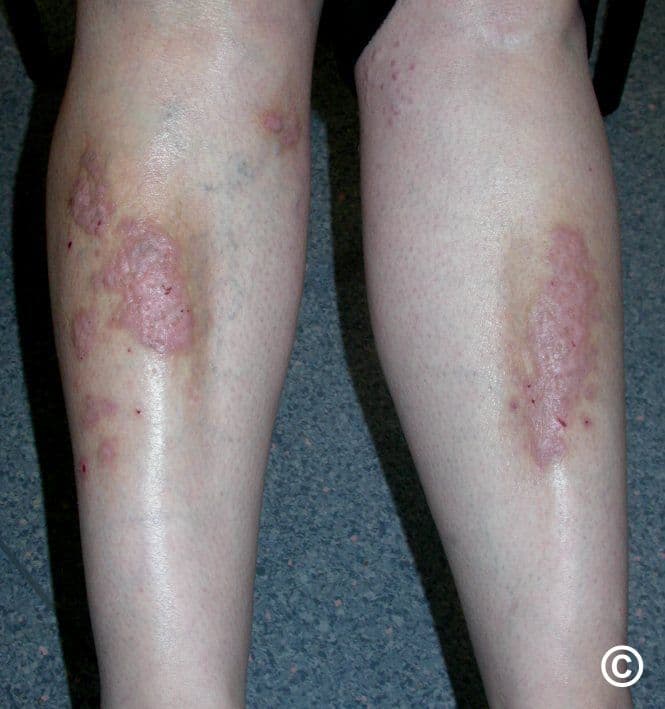
What is lichen simplex chronicus?
Lichen simplex chronicus is a patch of skin that has become thick, leathery and intensely itchy because it has been scratched or rubbed for a long time (DermNet, BAD). The skin's own itch drives the scratching, and every round of scratching makes the next itch stronger. Doctors call this the itch-scratch cycle (DermNet, AAD).
The condition also goes by the names neurodermatitis, lichen simplex and circumscribed neurodermatitis (DermNet, PCDS). They all describe the same thing: one or a few well-defined plaques of thickened skin, nearly always somewhere the hand can easily reach (DermNet, NEA). It is not an infection: you cannot catch it from anyone and you cannot pass it on (AAD, BAD).
Lichen planus is a different disease. iDerma has a separate article on lichen planus, and the next section explains how the two differ, because the two names are often mixed up.
Lichen simplex chronicus vs lichen planus: the names are the only thing they share
"Lichen" is an old Latin word for a plant-like moss growing on trees and rocks (BAD). It says nothing about the cause. Lichen simplex chronicus is the skin's response to being scratched; lichen planus is an inflammatory disease in which the body's own immune cells attack the skin and mucous membranes (DermNet).
| Lichen simplex chronicus | Lichen planus | |
|---|---|---|
| What causes it | Months of scratching or rubbing one itchy area, with or without an underlying skin condition (DermNet) | An immune reaction against the skin; triggers can include stress, skin injury, some infections and some medicines (DermNet) |
| What you see | One or a few large plaques of thickened, leathery skin with exaggerated criss-cross skin lines and scale (DermNet) | Many small, shiny, flat-topped, angular bumps that can merge into plaques, often crossed by fine white lines (DermNet, NHS) |
| Colour | Pink or red at first, then brownish; in darker skin mainly darker or paler than the surrounding skin (DermNet, NEA, MedlinePlus) | Purple or violet when new, fading to greyish-brown marks (DermNet) |
| Where | Wherever you can reach: nape and sides of the neck, scalp, wrists and forearms, ankles and shins, thighs, genitals (DermNet, PCDS) | Front of the wrists, lower back and ankles most often; also the mouth, genitals, nails and scalp (DermNet, NHS) |
| Mouth, nails, hair | Mouth and nails are spared; broken hairs or a bald patch can appear inside a scratched plaque on the scalp (DermNet) | White lacy patches in the mouth, ridged or thinning nails and scarring hair loss are all possible (NHS, DermNet) |
| Course | Settles when the scratching stops and the inflammation is treated, but tends to return if the cause of the itch is not found (BAD) | Skin lesions usually clear on their own in about 9 to 18 months and rarely return once cleared (NHS) |
A dermatologist tells them apart by looking: the large single plaque with magnified skin lines points to lichen simplex, while the scattered shiny purple bumps with white lines point to lichen planus. If the picture is unclear, a small skin biopsy settles it (DermNet). The treatments overlap only partly, so the distinction matters.
Who gets it?
Lichen simplex chronicus is relatively common (DermNet). It mostly affects adults, with a peak between 30 and 50 years, and women about twice as often as men (DermNet, PCDS). Skin colour does not change the risk, although the plaques look different in darker skin, where colour change dominates and redness is hard to see (DermNet).
Three backgrounds make it more likely (DermNet, PCDS, NEA):
- An itchy skin condition already present, above all atopic dermatitis, but also psoriasis or very dry skin (DermNet).
- Anxiety or long-term stress. A large population study found that an anxiety disorder raised the risk of lichen simplex chronicus (DermNet, citing Liao 2014), and people often date the start of the itch to a particularly stressful period (AAD).
- A personal tendency to lichenify. Not everyone's skin thickens in response to scratching; those whose skin does are more easily conditioned to scratch when itchy (PCDS).
It is rarely diagnosed in children, although some children with atopic dermatitis develop it, and atopic dermatitis itself thickens where a child scratches (BAD, NEA, DermNet).
Why the skin thickens: the itch-scratch cycle
Something makes a patch of skin itch. You scratch or rub it, which brings relief for a moment. Scratching damages the surface, the skin responds by growing thicker, and the thickened skin itches more than normal skin did (AAD, MedlinePlus). After weeks or months the plaque is leathery, the skin lines stand out in an exaggerated pattern, and the itch has become partly independent of whatever started it, because chronic itch sensitises the nerves themselves (DermNet).
Two things make this cycle so hard to break. First, the itch is often strongest when you are relaxing or trying to fall asleep, and many people scratch in their sleep without knowing it (AAD, MedlinePlus). Second, scratching an itch of this kind is genuinely pleasurable: brain imaging shows it lights up the brain's reward pathways (NEA). Some people stop noticing that they are scratching at all (AAD). This is why treatment includes physical barriers and habit-reversal techniques instead of relying on willpower (DermNet, BAD).
What starts the itch
Dermatologists separate two situations (DermNet):
- Primary lichen simplex develops on skin that was normal to begin with. Sometimes no cause can be identified (BAD).
- Secondary lichen simplex grows on top of another itchy condition: atopic dermatitis, psoriasis, scabies, very dry skin, contact dermatitis, varicose (stasis) eczema around the ankles, or a healed insect bite (DermNet, BAD).
Other recognised starting points (DermNet, BAD, NEA):
- Nerve-related itch. An irritated or damaged nerve can make one area of skin itch without any rash, for example the outer forearm in brachioradial pruritus, the skin beside a shoulder blade in notalgia paraesthetica, or after a back injury, shingles or a stroke (DermNet, BAD). Scratching that itch then produces the plaque.
- Illness elsewhere in the body. Kidney disease, some blood disorders and internal cancers can cause itch that leads to the same scratching (DermNet).
- Everyday triggers. Heat and sweating, rough or tight clothing, wool and synthetic fabrics, chemical irritants and insect bites (DermNet, NEA).
- Stress and low mood. Stress is described as a significant trigger, and the itch often begins during a stressful period (NEA, AAD).
Finding and treating the starting point is what keeps the plaque from coming back once it has been settled (DermNet, BAD).
What it looks and feels like
The itch comes first and dominates. It arrives in bursts, is often described as out of proportion to what the skin looks like, and is worst at rest and at night (PCDS, BAD). It can wake people from sleep (AAD).
The plaque itself (DermNet, PCDS, BAD):
- A well-defined area of thickened skin, usually a single plaque, sometimes two or three.
- Exaggerated skin lines in a criss-cross pattern (DermNet), the hallmark of lichenification. The surface feels dry, rough and leathery, and in very long-standing plaques can become warty.
- Scale on the surface and, in the early weeks, redness; later the colour turns brownish (PCDS, MedlinePlus). In darker skin the plaque is mainly darker, sometimes paler, than the skin around it (DermNet).
- Scratch marks, small erosions, crusts or bleeding points from recent scratching, and a rim of small firm bumps around the main plaque.
- Broken hairs or a thinned patch where the plaque sits on hairy skin, from the hairs being snapped off by scratching (DermNet).
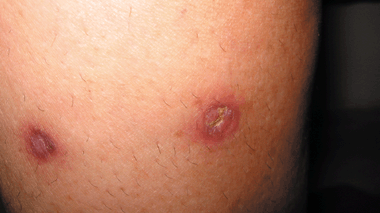
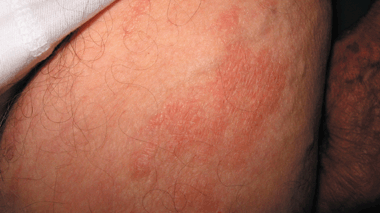
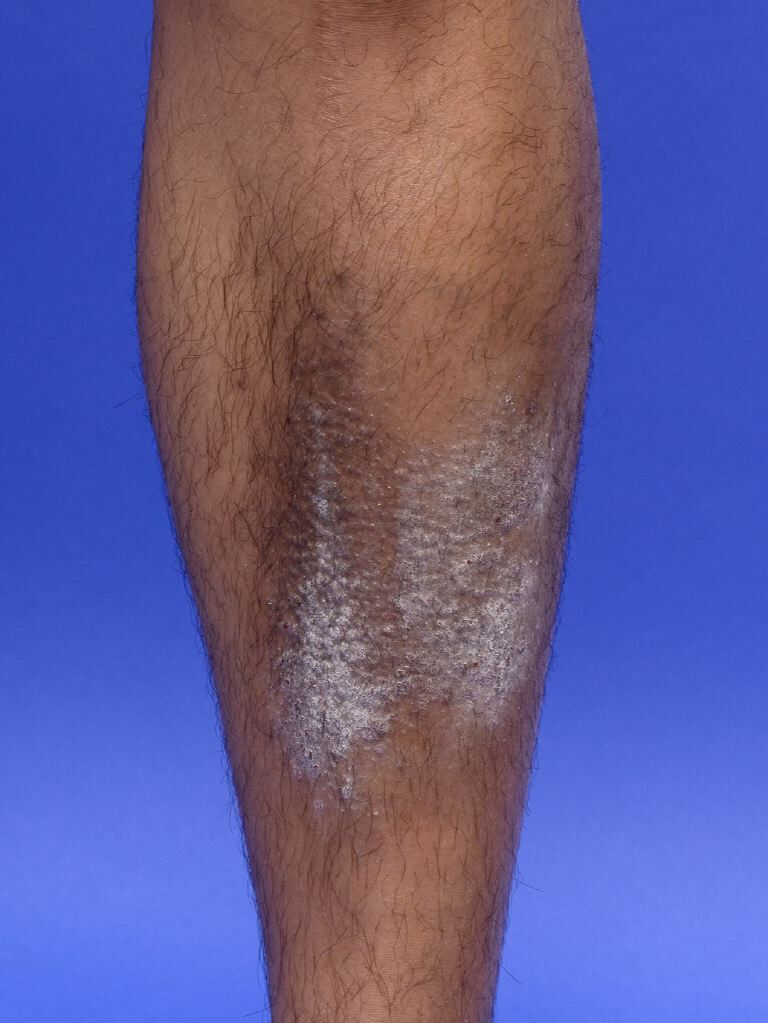
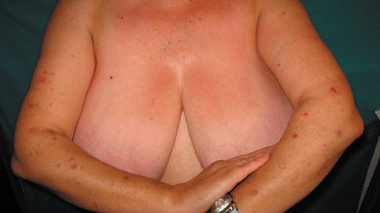
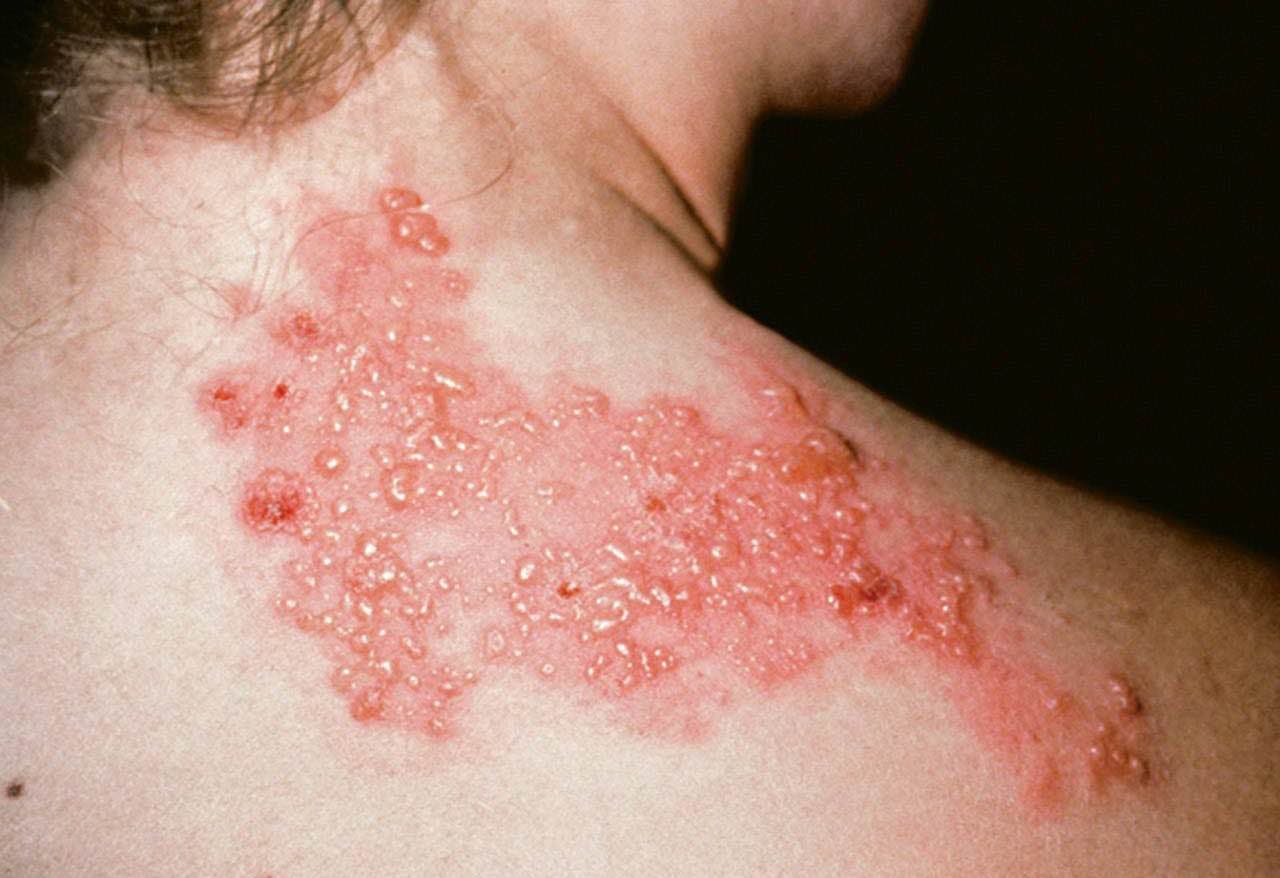
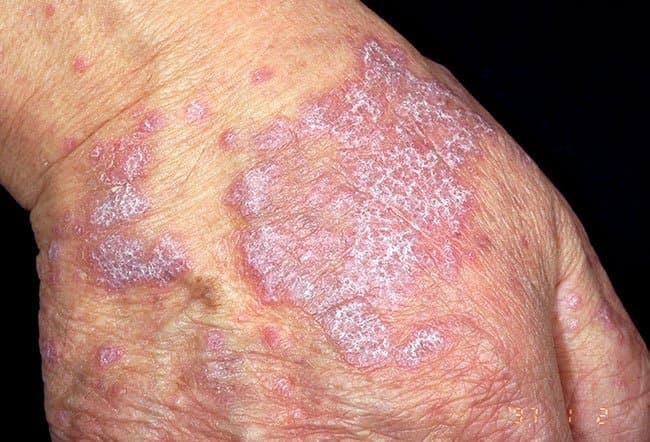
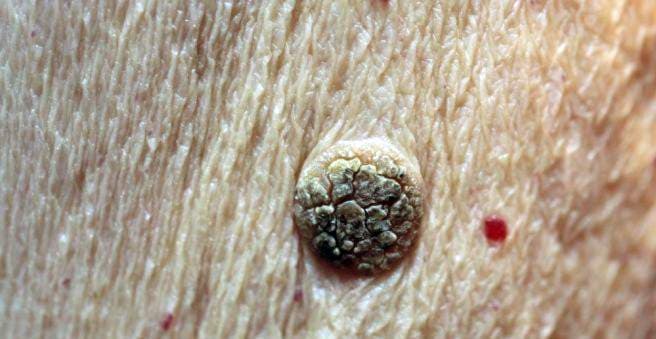
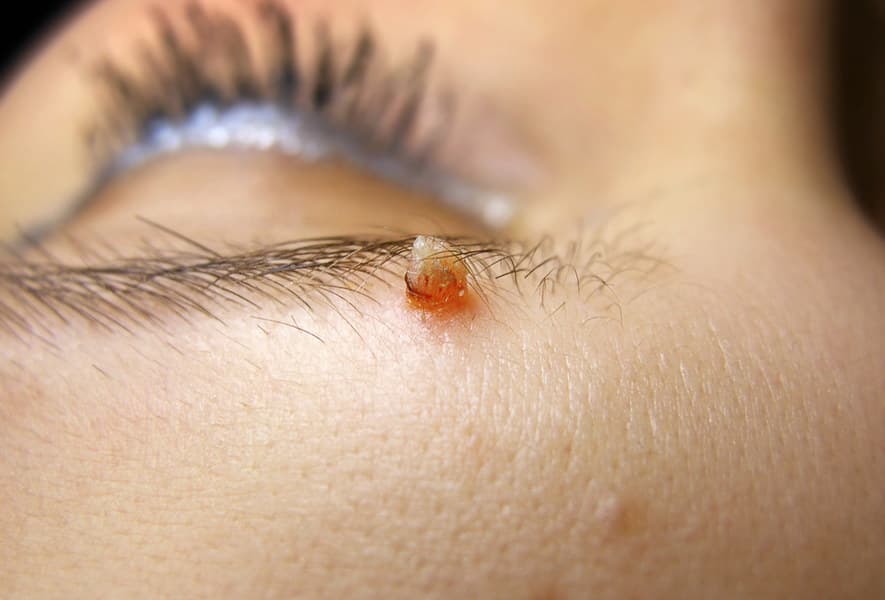
The photographs above come from the iDerma image library and show scratched, thickened skin on the limbs and trunk. On lighter skin such plaques read pink-red to brown; on darker skin the colour change is usually the most obvious sign (DermNet).
If the skin is broken, bacteria can move in. A sudden change to weeping, honey-coloured crusts, pain or spreading redness means the plaque has become infected and needs its own treatment (BAD, DermNet, MedlinePlus).
Where it appears
Almost always somewhere the hand reaches without effort (DermNet, PCDS, BAD):
- Nape and sides of the neck, the classic site in women, and the scalp.
- Wrists, outer forearms and elbows.
- Ankles, outer shins and thighs.
- Genital and anal skin: the vulva, the scrotum and the skin around the anus (DermNet, AAD).
- The eyelids, hands, feet and shoulders are also listed as sites (NEA).
Genital lichen simplex
On the vulva the thickening is often on both sides but worse on the side opposite the dominant hand (PCDS). Genital lichen simplex deserves a dermatologist's assessment rather than self-treatment, because other conditions of this area look similar and need different care, among them lichen sclerosus, which can coexist with lichen simplex (DermNet), fungal infection and lichen planus. In iDerma's experience people hesitate to mention genital itch, yet it is worth raising: lichen simplex settles with appropriate treatment, though it may come back unless the underlying cause is found (BAD).
Is it dangerous?
Lichen simplex chronicus is not infectious and not a serious disease (BAD). Its damage is to sleep, concentration and mood, and it can be considerable: people with chronic itch have higher rates of anxiety and depression, and the condition and the mood problem feed each other (DermNet, NEA).
The possible lasting marks are cosmetic (DermNet, MedlinePlus): a darker or paler patch after the plaque settles, which can take many months to fade and may be permanent in some people, and occasionally a scar where deep scratching or infection occurred. There is one reason a dermatologist takes a thick, persistent plaque seriously: a few uncommon conditions imitate it, including a rare skin lymphoma called mycosis fungoides and some early skin cancers, which is why a plaque that does not behave as expected is biopsied (DermNet, PCDS).
Conditions that look similar
The itch-scratch cycle is not unique to lichen simplex, and several conditions produce thick, itchy skin (DermNet, NEA). The table lists the conditions most often confused with it and what points away from lichen simplex chronicus.
| Condition | How it differs from lichen simplex chronicus |
|---|---|
| Lichen planus | Many small shiny purple flat-topped bumps with fine white lines, often on the wrists and ankles, sometimes in the mouth or on the nails (DermNet, NHS) |
| Atopic dermatitis (lichenified eczema) | Itchy patches typically in the elbow and knee creases; long-standing patches also thicken, and lichen simplex often grows on top of eczema (DermNet) |
| Psoriasis | Symmetrical red plaques with thick silvery scale on elbows, knees and scalp; itch is usually milder, though scratched psoriasis also lichenifies (DermNet) |
| Discoid (nummular) eczema | Several coin-shaped, well-defined, very itchy patches, often on the legs, which may weep or crust (DermNet) |
| Contact dermatitis | Matches the shape of whatever touched the skin; patch testing identifies the allergen (DermNet) |
| Ringworm (tinea) | A spreading ring-shaped patch; long-untreated ringworm can itself lichenify, so scrapings are sent when in doubt (DermNet, PCDS) |
| Prurigo nodularis | The same itch-scratch mechanism, but producing many firm, very itchy nodules under 1 cm scattered over the arms, legs and trunk instead of one thickened plaque (BAD) |
| Lichen amyloidosis | Scaly tan-brown bumps, often on the shins, from a protein deposit in the skin; more common in people of Asian, South American or Middle Eastern origin; scratching is thought to contribute (DermNet) |
| Mycosis fungoides | A rare skin lymphoma whose early patches can be mistaken for eczema or lichen simplex; the reason an atypical plaque is biopsied (DermNet, PCDS) |
| Lichen sclerosus | White, crinkled or thickened genital skin that tends to scar; may coexist with genital lichen simplex (DermNet) |
How it is diagnosed
The diagnosis is clinical. A dermatologist recognises the plaque by its look, its site and the story of months of itching and scratching (DermNet, BAD). Tests are used to exclude look-alikes and to find what started the itch (DermNet, PCDS):
- Skin scrapings for fungal culture if a fungal infection is possible.
- Patch tests if contact dermatitis could be underneath; small amounts of common allergens are taped to the back for two days and read over the following days (DermNet).
- A skin biopsy if the plaque is atypical, to rule out lymphoma and other conditions. A 3 to 4 mm punch of skin is taken under local anaesthetic and leaves a small wound (DermNet).
- Blood tests for thyroid, kidney and liver function and a full blood count, to look for an underlying cause of the itch (DermNet).
In iDerma's experience lichen simplex chronicus is one of the conditions that can usually be recognised from good photographs together with a description of how long the area has itched and what makes it worse, so an online consultation is a reasonable first step. The dermatologist will say when an in-person examination, a biopsy or patch testing is needed instead, and genital lichen simplex more often needs an examination.
Treatment: breaking the cycle
Treatment has three aims at once: calm the inflammation and the itch, protect the skin from the hand, and deal with whatever started the itching (DermNet, BAD). Combinations of treatments are often needed, for several weeks or months (BAD, NEA). Specific medicines are prescribed by your dermatologist according to the site, the thickness of the plaque and your skin; the classes below are what that plan is usually built from.
- Emollients, generously and often. Apply a fragrance-free moisturiser at least twice a day and after every wash, and use a soap substitute instead of soap, shower gel or bubble bath (DermNet, BAD). Applying moisturiser whenever the skin itches, instead of scratching, is a treatment in itself (BAD).
- A cooling cream kept in the fridge and applied when the itch flares; it may sting on broken skin (BAD).
- A steroid cream or ointment, usually a strong one, applied thinly once a day until the plaque flattens and the itch settles (PCDS, BAD). On thin skin such as the genitals a milder preparation is used (DermNet). Repeated courses are often needed (BAD).
- Covering the plaque (occlusion). A dressing, medicated tape or plaster, a tubular bandage or a paste bandage over the treated skin increases the effect of the cream and, just as importantly, puts a barrier between the plaque and your fingernails (DermNet, PCDS, BAD). Paste bandages are changed once or twice a week until the plaque flattens (PCDS).
- A steroid injection into the plaque for stubborn, very thick areas (DermNet, BAD).
- Steroid-free anti-inflammatory creams, a prescription class that reduces inflammation and itch (DermNet, BAD).
- Creams that calm the nerve endings, prescribed when the itch is thought to be nerve-driven (DermNet, BAD).
- A sedating antihistamine tablet at bedtime for a few weeks when night-time itch is wrecking sleep; it can cause drowsiness and affect driving (DermNet, BAD).
- Second-line tablets that act on itch signalling in the nerves, prescribed and monitored by a specialist for persistent cases (DermNet, BAD).
- Treating infection with an antiseptic or a short course of an antibiotic preparation when the skin has become infected; antibiotic creams are for short courses only (BAD).
- Habit-reversal and stress-reduction therapy. Learning to notice the urge and substitute another action (pressing, holding something cold) is part of standard treatment, especially when scratching has become automatic (DermNet, BAD, AAD).
- Phototherapy with ultraviolet light in a dermatology department, or tablets that dampen the immune system, for widespread or treatment-resistant lichen simplex (BAD, DermNet). These are needed only occasionally.
Whatever started the itch is treated alongside: the eczema, the psoriasis, the fungal infection, the dry skin, the nerve problem or the illness elsewhere (DermNet, BAD).
What does not help
Scratching for relief, hot or long showers and baths, soap, shower gel and perfumed products all feed the cycle (BAD, NHS). Stopping treatment as soon as the itch eases invites the plaque back: the guidance is to continue until the plaque has flattened and the itch has settled (PCDS).
Daily care that makes treatment work
These are the habits the dermatologist will ask you to keep up during treatment and for a while afterwards (BAD, NHS, MedlinePlus, DermNet):
- Moisturise morning and evening and after washing; use a soap substitute.
- Wear loose cotton or silk next to the skin; avoid wool and synthetic fabrics over the plaque.
- Keep nails short, clean and smooth. Wear thin cotton gloves at night if you wake to find you have scratched.
- Keep the bedroom cool; heat and sweating intensify itch.
- Pat or tap the skin, or hold something cool against it, instead of scratching.
- Work on stress and sleep: breathing or relaxation exercises, a regular sleep schedule, and psychological support if anxiety or low mood is part of the picture.
- iDerma dermatologists also suggest a short itch diary for two weeks: when the itch flares, what you were doing, what you were wearing. It often reveals the trigger.
How long it takes and whether it comes back
Combinations of treatment may be needed for several weeks or months before a plaque resolves (BAD). In iDerma's experience the itch eases first, and the thickened skin and its colour change take longer to flatten and fade. The condition is chronic by nature: it can clear completely, but it is prone to return, especially when treatment is stopped early or the underlying cause of the itch is left untreated (DermNet, BAD). A plaque that keeps recurring at the same site is a reason to look harder for the trigger.
A settled plaque can leave the skin darker or paler. The darker form is post-inflammatory hyperpigmentation, which fades over months and is more pronounced and longer-lasting in darker skin; paler patches can be permanent (DermNet). Broken hairs and thinning within a plaque are well described (DermNet); in iDerma's experience the hair regrows once the skin recovers and the scratching has stopped.
When to see a dermatologist
- An itchy patch has lasted more than a few weeks, is thickening, or keeps returning in the same place.
- Itch wakes you at night or stops you doing things you want to do, such as sport or dating (AAD).
- The plaque is on the genitals, around the anus or on the eyelids, where self-treatment is not appropriate.
- The skin has become weepy, crusted, painful or increasingly red, or you have a fever (MedlinePlus, BAD).
- Over-the-counter moisturisers and cooling creams have not helped, or the itch keeps coming back (NHS).
- You itch all over, not just in one place; widespread itch needs a general medical check (NHS).
What to do now
Photograph the plaque in daylight, once from a distance to show where it is and once close up, and note how long it has itched, what makes it worse and anything you have already tried. An iDerma dermatologist can assess this through an online consultation, confirm whether it is lichen simplex chronicus or one of its look-alikes, start treatment and tell you whether an examination, patch testing or a biopsy is needed. Until then: moisturise instead of scratching, keep the area covered with a soft dressing, and keep your nails short.